



Choose a white gold engagement ring's band pairing by looking beyond identical details. The right match follows the engagement ring's profile, proportions, surface finish, diamond rhythm, and the way you actually wear your jewelry. Use this guide to evaluate two pieces designed to live together on one hand.
Explore white gold engagement rings at Kravit Jewelers
How can a white gold engagement ring band pairing look like a matching set?
Short answer: A matching set repeats one or two visual cues without making both rings identical. The strongest pair usually shares a metal color, complements the engagement ring's profile, and uses balanced width and diamond detail. A wedding band can add contrast through texture or contour while still looking intentional beside the center ring.
Think of coordination as a hierarchy. First, solve the physical fit. Next, balance the visual weight. Then decide whether the band should echo, soften, or contrast with the engagement ring. This order matters because a beautiful band that cannot sit comfortably beside the setting will not feel like the right choice in daily life.
White gold gives a cohesive foundation because both pieces have a cool, bright appearance. The pairing can still feel distinctive when one ring has a high-polish finish and the other has milgrain, satin, or fine engraved detail. The goal is harmony, not duplication.
How should the engagement ring and band fit together?
Short answer: Start with the base of the engagement ring, not the top view. A straight wedding band may sit flush with a low, open shank, while a curved, contoured, or shadow band may work better around a center setting that extends toward the finger. Try the actual engagement ring with candidate bands before deciding.
The setting profile determines the available space. A solitaire with a simple shank often accepts a straight band naturally. A halo, cathedral setting, raised shoulder, or detailed under-gallery may require a band that curves around the setting or sits slightly below it. A deliberate gap can also be attractive, but it should be a chosen design feature rather than an unexpected fit problem.
Ask these questions while trying on the pair:
- Do the rings meet where you want them to, or does the setting force a gap?
- Does the band press against a prong, halo edge, or lower gallery?
- Can both rings move comfortably when you bend your finger?
- Does the pair stay aligned when you move your hand?
- Would a fitted band protect the side of the engagement ring or create extra contact?
A jeweler can assess the ring from the side and measure the space beneath the center stone. That view is often more useful than judging the pair in a display tray. If the engagement ring is already part of your collection, bring it to the appointment so the band is chosen around the real profile.
Which widths create balanced proportions?
Short answer: A wedding band that is equal to or slightly narrower than the engagement ring's shank often creates a balanced stack. The best width depends on the center stone, shoulder design, finger proportions, and whether you plan to wear the band alone. Compare several widths together instead of choosing from a number alone.
Width changes the visual conversation between the two rings. A slender band can keep attention on a substantial center stone or detailed setting. A medium-width band can give a simple solitaire more presence. A wider band may suit an architectural engagement ring, but it can compete with delicate shoulders or make the stack feel heavier than intended.
Remember that visual balance is not the same as equal measurement. The setting may make one ring appear larger, even when the shanks are similar. Evaluate the completed stack on your hand before treating a width difference as a problem.
| Band approach | How it tends to look | When to consider it |
|---|---|---|
| Slender. | Light, refined, and secondary to the center ring. | The engagement ring has a prominent stone or detailed shoulders. |
| Moderate. | Balanced and clearly present without dominating. | The engagement ring has a simple or medium-weight shank. |
| Substantial. | Bold, architectural, and visually equal to the engagement ring. | Both rings have enough scale to share attention comfortably. |
Do not evaluate width only from above. Turn your hand sideways, make a gentle fist, and notice where the rings touch.
A band that looks perfect in a flat display may feel too wide between the fingers. A professional fitting also helps distinguish a proportion issue from a sizing issue. Compare one additional width before you decide.
How can texture and finish coordinate?
Short answer: Coordinate finish by choosing one dominant surface and one supporting surface. Two high-polish white gold rings look crisp and classic. A polished engagement ring with a softly brushed or milgrain band creates measured contrast. Keep the profiles and widths aligned so the finish difference reads as intentional rather than mismatched.
Surface finish changes how light travels across the set. High polish reflects the showroom lighting and gives the pair a clean, bright look. Satin or brushed detail diffuses light and can make the band feel quieter. Milgrain adds a fine beaded edge that can support a vintage-inspired setting without copying every detail.
Texture is especially useful when the engagement ring already has a lot of diamond detail. A textured band can add interest without introducing a second row of stones. Conversely, a plain polished band can give a pave engagement ring a visual pause and help the center stone remain the focal point.
Ask how each finish will wear over time. Contact between rings can create marks, and a surface that begins with a strong contrast may soften as both pieces are worn. A jeweler can explain which finish is practical for your routine and how the pair can be inspected or refreshed when needed.
How much diamond detail belongs in the band?
Short answer: Let the engagement ring set the level of diamond detail, then decide whether the band should echo that rhythm or provide balance. A pave engagement ring may pair with a diamond band for continuity, while a substantial center stone can look elegant with a quieter band. The right amount is the level you enjoy wearing together.
There is no rule that the two rings must have the same number, size, or placement of diamonds. Instead, compare the pattern. Shared round stones can create a classic rhythm. Alternating shapes can add movement. A plain band can frame a detailed engagement ring, while a diamond band can give a minimalist solitaire more sparkle from the side.
Look for visual weight rather than specifications alone:
- Match the rhythm: Repeat a shared stone shape or spacing when you want a coordinated look.
- Balance the center: Choose a quieter band if the engagement ring has a halo, split shank, or strong side detail.
- Consider the profile: Raised diamond details can affect how closely the band sits against the engagement ring.
- Think beyond the ceremony: Decide whether you want to wear the band alone, where its detail should still feel complete.
Bring reference photos if you have a particular pattern in mind, but use them to describe the feeling rather than to assume every design will fit your ring. A custom jewelry consultation can translate the idea into a band that follows the exact proportions of your engagement ring.
Compare wedding bands for a coordinated white gold set
What should everyday wear change about your choice?
Short answer: Everyday wear should influence the band profile, edge, width, and amount of exposed detail. Choose a pair that feels stable when you type, drive, work, and move your hands. The most successful matching set is one you can wear comfortably, not just one that photographs well during the proposal or ceremony.
Notice the edges between the rings and the fingers. A sharp edge, raised detail, or wide combination may feel distracting even when the top view is beautiful. If you wear the engagement ring alone often, compare the band both with and without it. The band should have its own appeal and should not feel like an unfinished piece when worn separately.
Your routine can guide the balance between intricate design and easy wear. Customers who work with their hands may prefer smoother edges and a lower profile. Someone who wants maximum sparkle may accept more exposed detail and plan for periodic professional inspection. Neither approach is universally correct, which is why an in-person try-on is valuable.
Also consider how the rings will be maintained together. White gold pieces can develop different surface appearances if they are worn, polished, or serviced on different schedules. Keeping the set together for future inspections helps a jeweler evaluate contact points, fit, and finish as a pair.
How can you compare a set in person?
Short answer: Compare a matching set in person by wearing the engagement ring and band together. Viewing them from the top and side, moving your hand naturally, and testing the band alone. Bring the ring you already own, or try a setting with a similar profile. This reveals comfort and fit that photographs cannot show.
Use a focused appointment rather than trying to decide from a tray of unrelated rings. Begin with a small group of bands that match the engagement ring's metal color. Then narrow the choices by profile, width, texture, and diamond detail. This sequence keeps the decision practical and prevents a beautiful but incompatible style from taking over the conversation.
- Place the two rings together and check whether the profiles meet as intended.
- View the stack from above, from the side, and at a natural hand angle.
- Open and close your hand to notice pressure, movement, or catching.
- Compare a plain, textured, and diamond-accented option if the setting allows it.
- Try the wedding band alone to confirm that it feels complete for future wear.
- Ask what can be adjusted through contour, width, finish, or custom design.
Kravit Jewelers serves couples in Oceanside and surrounding Long Island communities with personalized guidance for engagement rings, wedding bands, and custom jewelry. If a ready-to-wear band does not create the fit you want, a consultation can help define the right proportions before a design is finalized.
Request a custom jewelry consultation for your matching set
Frequently Asked Questions About White Gold Matching Sets
Do white gold engagement rings and wedding bands have to match exactly?
No. They should coordinate in metal color and visual weight, but the finish, texture, or diamond pattern can differ. A polished engagement ring may pair well with a softly textured band when the profiles and proportions work together.
Should a wedding band be narrower than an engagement ring?
Often, a band that is equal to or slightly narrower than the engagement ring's shank looks balanced. The correct choice depends on the setting, center stone, finger proportions, and how substantial you want the complete stack to feel.
Can a straight band sit flush with any engagement ring?
No. A straight band may sit flush with an open or simple shank, but a halo, cathedral, or contoured setting may require a curved or fitted band. Try the actual rings together before assuming the fit.
Is a diamond wedding band necessary with a diamond engagement ring?
No. A plain or textured white gold band can create a calm frame around a diamond engagement ring. If you prefer more sparkle, choose diamond detail that complements the engagement ring's rhythm without overwhelming its center stone.
What if I cannot find a ready-made band that fits?
A custom jewelry consultation may help when the engagement ring has a distinctive contour, an unusual profile, or a specific texture that is difficult to match. Bring the engagement ring so the band can be designed around its real measurements.
Request a custom jewelry consultation for your matching set
The best white gold engagement ring and band pairing feels deliberate from every angle and comfortable through an ordinary day. Start with the physical fit, compare widths, coordinate the surfaces, and choose diamond detail that supports the engagement ring. With the right guidance, your set can look cohesive without losing the character of either ring.
Choose a white gold engagement ring's band pairing by looking beyond identical details. The right match follows the engagement ring's profile, proportions, surface finish, diamond rhythm, and the way you actually wear your jewelry. Use this guide to evaluate two pieces designed to live together on one hand.
Explore white gold engagement rings at Kravit Jewelers
How can a white gold engagement ring band pairing look like a matching set?
Short answer: A matching set repeats one or two visual cues without making both rings identical. The strongest pair usually shares a metal color, complements the engagement ring's profile, and uses balanced width and diamond detail. A wedding band can add contrast through texture or contour while still looking intentional beside the center ring.
Think of coordination as a hierarchy. First, solve the physical fit. Next, balance the visual weight. Then decide whether the band should echo, soften, or contrast with the engagement ring. This order matters because a beautiful band that cannot sit comfortably beside the setting will not feel like the right choice in daily life.
White gold gives a cohesive foundation because both pieces have a cool, bright appearance. The pairing can still feel distinctive when one ring has a high-polish finish and the other has milgrain, satin, or fine engraved detail. The goal is harmony, not duplication.
How should the engagement ring and band fit together?
Short answer: Start with the base of the engagement ring, not the top view. A straight wedding band may sit flush with a low, open shank, while a curved, contoured, or shadow band may work better around a center setting that extends toward the finger. Try the actual engagement ring with candidate bands before deciding.
The setting profile determines the available space. A solitaire with a simple shank often accepts a straight band naturally. A halo, cathedral setting, raised shoulder, or detailed under-gallery may require a band that curves around the setting or sits slightly below it. A deliberate gap can also be attractive, but it should be a chosen design feature rather than an unexpected fit problem.
Ask these questions while trying on the pair:
- Do the rings meet where you want them to, or does the setting force a gap?
- Does the band press against a prong, halo edge, or lower gallery?
- Can both rings move comfortably when you bend your finger?
- Does the pair stay aligned when you move your hand?
- Would a fitted band protect the side of the engagement ring or create extra contact?
A jeweler can assess the ring from the side and measure the space beneath the center stone. That view is often more useful than judging the pair in a display tray. If the engagement ring is already part of your collection, bring it to the appointment so the band is chosen around the real profile.
Which widths create balanced proportions?
Short answer: A wedding band that is equal to or slightly narrower than the engagement ring's shank often creates a balanced stack. The best width depends on the center stone, shoulder design, finger proportions, and whether you plan to wear the band alone. Compare several widths together instead of choosing from a number alone.
Width changes the visual conversation between the two rings. A slender band can keep attention on a substantial center stone or detailed setting. A medium-width band can give a simple solitaire more presence. A wider band may suit an architectural engagement ring, but it can compete with delicate shoulders or make the stack feel heavier than intended.
Remember that visual balance is not the same as equal measurement. The setting may make one ring appear larger, even when the shanks are similar. Evaluate the completed stack on your hand before treating a width difference as a problem.
| Band approach | How it tends to look | When to consider it |
|---|---|---|
| Slender. | Light, refined, and secondary to the center ring. | The engagement ring has a prominent stone or detailed shoulders. |
| Moderate. | Balanced and clearly present without dominating. | The engagement ring has a simple or medium-weight shank. |
| Substantial. | Bold, architectural, and visually equal to the engagement ring. | Both rings have enough scale to share attention comfortably. |
Do not evaluate width only from above. Turn your hand sideways, make a gentle fist, and notice where the rings touch.
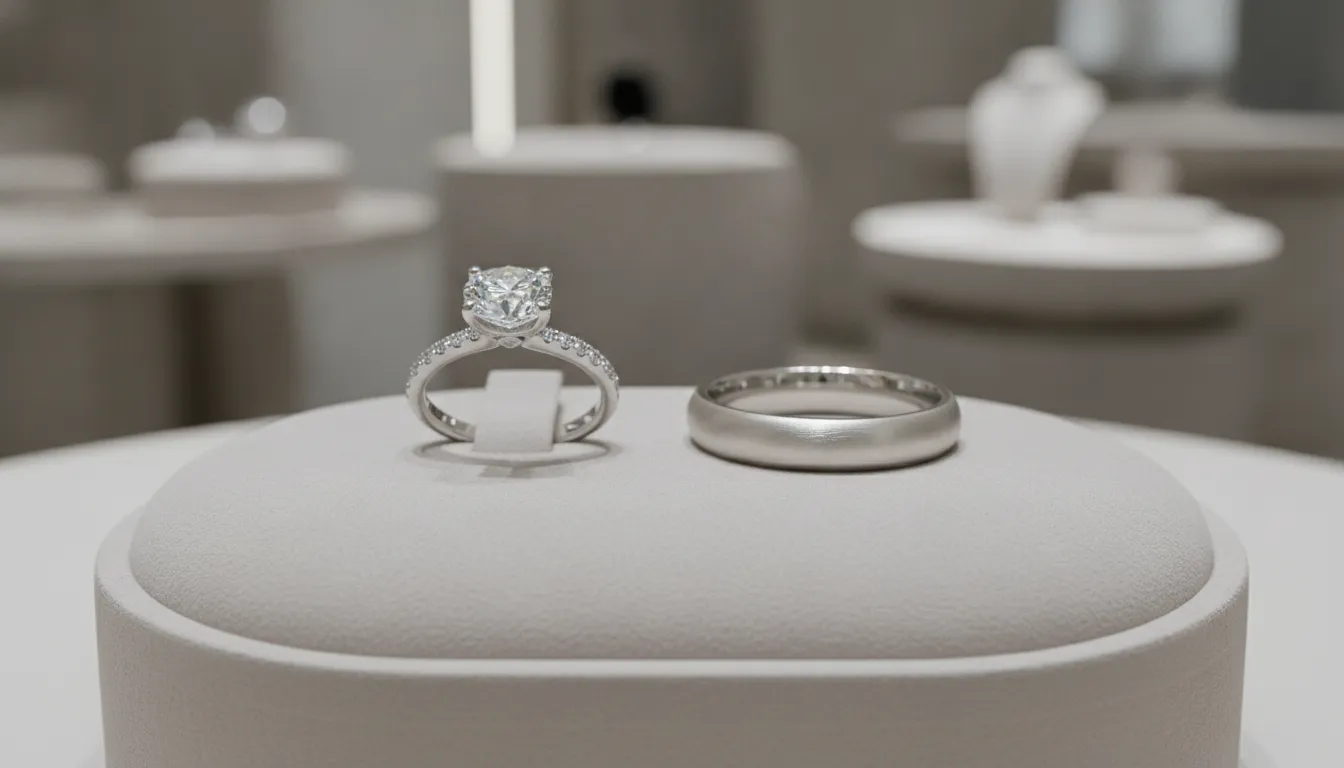
A band that looks perfect in a flat display may feel too wide between the fingers. A professional fitting also helps distinguish a proportion issue from a sizing issue. Compare one additional width before you decide.
How can texture and finish coordinate?
Short answer: Coordinate finish by choosing one dominant surface and one supporting surface. Two high-polish white gold rings look crisp and classic. A polished engagement ring with a softly brushed or milgrain band creates measured contrast. Keep the profiles and widths aligned so the finish difference reads as intentional rather than mismatched.
Surface finish changes how light travels across the set. High polish reflects the showroom lighting and gives the pair a clean, bright look. Satin or brushed detail diffuses light and can make the band feel quieter. Milgrain adds a fine beaded edge that can support a vintage-inspired setting without copying every detail.
Texture is especially useful when the engagement ring already has a lot of diamond detail. A textured band can add interest without introducing a second row of stones. Conversely, a plain polished band can give a pave engagement ring a visual pause and help the center stone remain the focal point.
Ask how each finish will wear over time. Contact between rings can create marks, and a surface that begins with a strong contrast may soften as both pieces are worn. A jeweler can explain which finish is practical for your routine and how the pair can be inspected or refreshed when needed.
How much diamond detail belongs in the band?
Short answer: Let the engagement ring set the level of diamond detail, then decide whether the band should echo that rhythm or provide balance. A pave engagement ring may pair with a diamond band for continuity, while a substantial center stone can look elegant with a quieter band. The right amount is the level you enjoy wearing together.
There is no rule that the two rings must have the same number, size, or placement of diamonds. Instead, compare the pattern. Shared round stones can create a classic rhythm. Alternating shapes can add movement. A plain band can frame a detailed engagement ring, while a diamond band can give a minimalist solitaire more sparkle from the side.
Look for visual weight rather than specifications alone:
- Match the rhythm: Repeat a shared stone shape or spacing when you want a coordinated look.
- Balance the center: Choose a quieter band if the engagement ring has a halo, split shank, or strong side detail.
- Consider the profile: Raised diamond details can affect how closely the band sits against the engagement ring.
- Think beyond the ceremony: Decide whether you want to wear the band alone, where its detail should still feel complete.
Bring reference photos if you have a particular pattern in mind, but use them to describe the feeling rather than to assume every design will fit your ring. A custom jewelry consultation can translate the idea into a band that follows the exact proportions of your engagement ring.
Compare wedding bands for a coordinated white gold set
What should everyday wear change about your choice?
Short answer: Everyday wear should influence the band profile, edge, width, and amount of exposed detail. Choose a pair that feels stable when you type, drive, work, and move your hands. The most successful matching set is one you can wear comfortably, not just one that photographs well during the proposal or ceremony.
Notice the edges between the rings and the fingers. A sharp edge, raised detail, or wide combination may feel distracting even when the top view is beautiful. If you wear the engagement ring alone often, compare the band both with and without it. The band should have its own appeal and should not feel like an unfinished piece when worn separately.
Your routine can guide the balance between intricate design and easy wear. Customers who work with their hands may prefer smoother edges and a lower profile. Someone who wants maximum sparkle may accept more exposed detail and plan for periodic professional inspection. Neither approach is universally correct, which is why an in-person try-on is valuable.
Also consider how the rings will be maintained together. White gold pieces can develop different surface appearances if they are worn, polished, or serviced on different schedules. Keeping the set together for future inspections helps a jeweler evaluate contact points, fit, and finish as a pair.
How can you compare a set in person?
Short answer: Compare a matching set in person by wearing the engagement ring and band together. Viewing them from the top and side, moving your hand naturally, and testing the band alone. Bring the ring you already own, or try a setting with a similar profile. This reveals comfort and fit that photographs cannot show.
Use a focused appointment rather than trying to decide from a tray of unrelated rings. Begin with a small group of bands that match the engagement ring's metal color. Then narrow the choices by profile, width, texture, and diamond detail. This sequence keeps the decision practical and prevents a beautiful but incompatible style from taking over the conversation.
- Place the two rings together and check whether the profiles meet as intended.
- View the stack from above, from the side, and at a natural hand angle.
- Open and close your hand to notice pressure, movement, or catching.
- Compare a plain, textured, and diamond-accented option if the setting allows it.
- Try the wedding band alone to confirm that it feels complete for future wear.
- Ask what can be adjusted through contour, width, finish, or custom design.
Kravit Jewelers serves couples in Oceanside and surrounding Long Island communities with personalized guidance for engagement rings, wedding bands, and custom jewelry. If a ready-to-wear band does not create the fit you want, a consultation can help define the right proportions before a design is finalized.
Request a custom jewelry consultation for your matching set
Frequently Asked Questions About White Gold Matching Sets
Do white gold engagement rings and wedding bands have to match exactly?
No. They should coordinate in metal color and visual weight, but the finish, texture, or diamond pattern can differ. A polished engagement ring may pair well with a softly textured band when the profiles and proportions work together.
Should a wedding band be narrower than an engagement ring?
Often, a band that is equal to or slightly narrower than the engagement ring's shank looks balanced. The correct choice depends on the setting, center stone, finger proportions, and how substantial you want the complete stack to feel.
Can a straight band sit flush with any engagement ring?
No. A straight band may sit flush with an open or simple shank, but a halo, cathedral, or contoured setting may require a curved or fitted band. Try the actual rings together before assuming the fit.
Is a diamond wedding band necessary with a diamond engagement ring?
No. A plain or textured white gold band can create a calm frame around a diamond engagement ring. If you prefer more sparkle, choose diamond detail that complements the engagement ring's rhythm without overwhelming its center stone.
What if I cannot find a ready-made band that fits?
A custom jewelry consultation may help when the engagement ring has a distinctive contour, an unusual profile, or a specific texture that is difficult to match. Bring the engagement ring so the band can be designed around its real measurements.
Request a custom jewelry consultation for your matching set
The best white gold engagement ring and band pairing feels deliberate from every angle and comfortable through an ordinary day. Start with the physical fit, compare widths, coordinate the surfaces, and choose diamond detail that supports the engagement ring. With the right guidance, your set can look cohesive without losing the character of either ring.


