



Gold buying prices today can look simple: find a market quote, weigh a piece, and estimate its value. In practice, a headline figure does not tell you what a particular ring, chain, or group of jewelry may be worth in a buying conversation. Purity, gold-bearing weight, construction, and the timing and basis of the reference all matter. Knowing what to ask can help you approach an evaluation with useful context rather than an expectation built on a single number.
What does a gold price reference actually tell you?
A published gold price is a reference for a specified amount of gold at a particular time. It is not automatically the amount a seller will receive for a finished piece of jewelry. The quoted figure may refer to a certain unit, such as a troy ounce, and to gold of a particular purity. A jewelry item is an alloy, may include other materials, and must be considered as an object rather than treated as a matching quantity of pure metal.
Prices move, so two references viewed at different times may not be directly comparable. A quote might also use a different unit or make different assumptions about purity. Before relying on a figure, check its date, unit, and what kind of gold it describes. These details do not produce an offer on their own, but they help you understand the starting point for a conversation.
The Federal Trade Commission is a government resource for consumer information about jewelry and precious-metal claims. Its consumer guidance and information can help you understand why clear descriptions matter; it cannot determine the composition or value of an individual piece.
How do karat and purity affect the estimate?
Karat describes the proportion of gold in an alloy. In general, a higher karat number means a greater proportion of gold by weight than a lower karat number. The balance is made up of other metals, which can affect the appearance and properties of the jewelry. Because of this difference in gold content, two pieces with the same total weight can have different material value.
A stamp can provide a useful clue about a piece, but it is not the whole evaluation. Marks can be tiny, worn, difficult to read, or absent. A stamped number also does not tell you how much of a mixed-material item is gold-bearing material. If a marking is important to your understanding, ask how it was interpreted and whether the estimate depends on that marking alone or on an assessment of the item.
For example, imagine two pieces that each weigh the same on a household scale. One bears a lower-karat mark and the other a higher-karat mark. The scale gives the same total weight, but the proportion of gold is different. If the items also have different clasps, stones, or construction, their estimates may differ further. This is why weight without purity is an incomplete comparison.
Why is total jewelry weight not always gold weight?
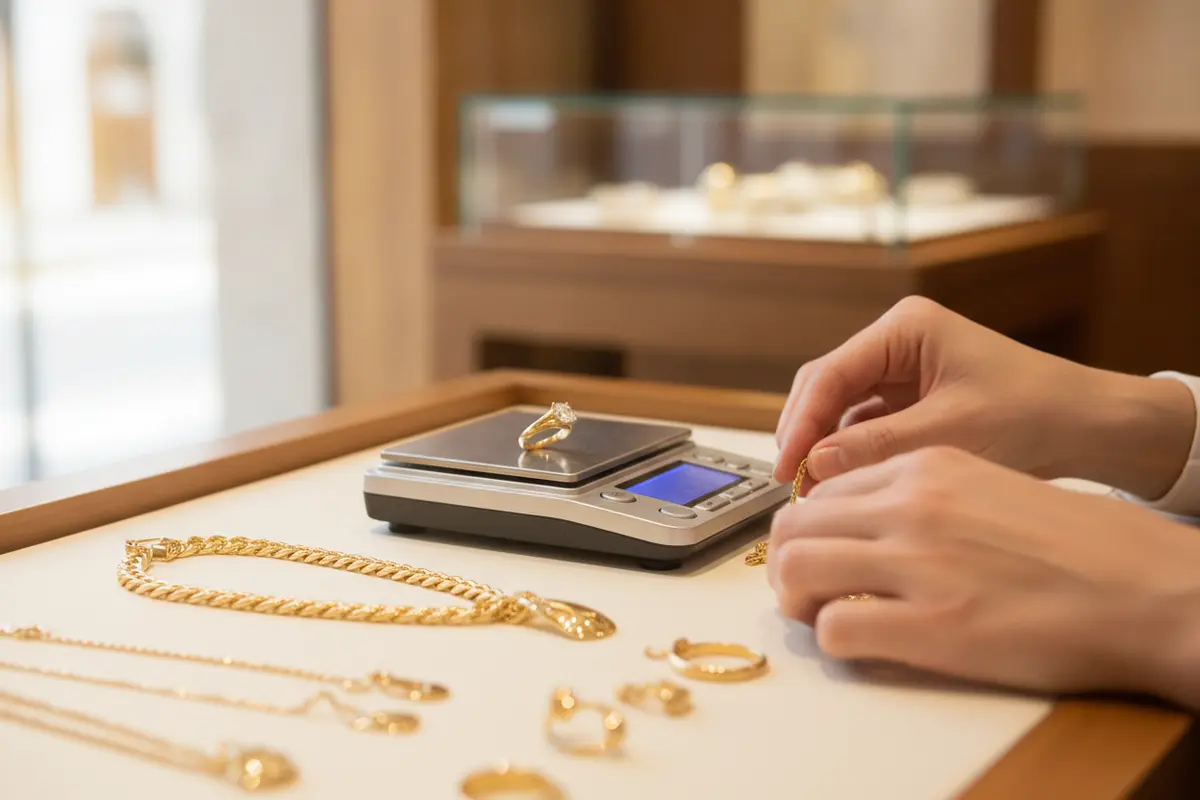
A finished piece can contain more than gold. A ring may hold a gemstone; a pendant may have a setting or insert; and a chain may have a clasp or parts made from a different material. The piece's total weight includes everything placed on the scale, while an estimate may need to account for which components contain gold and how the item is constructed.
Do not assume that a stone's weight automatically adds to the gold estimate, or that every non-gold component will be handled in the same way. Ask the evaluator to explain what was included in the weight and whether components were considered separately. The purpose is not to perform a calculation from memory; it is to understand how the estimate was formed.
| Factor | What to clarify | Why it matters |
|---|---|---|
| Market reference | Which date, unit, and gold basis are being used? | References change over time and may describe different quantities or purities. |
| Karat or purity | Is the mark clear, and how is the stated purity assessed? | Gold content can differ even when two pieces weigh the same. |
| Weight | Is this total item weight or gold-bearing material weight? | Stones and other materials can contribute to total weight. |
| Construction | Are clasps, solder, settings, or mixed materials considered? | A finished piece may contain components that are not the same material. |
| Purpose of the figure | Is this a buying estimate, appraisal, or another kind of assessment? | Different services answer different questions and should not be confused. |
Why can similar-looking pieces receive different estimates?
Appearance and scale weight do not reveal every relevant detail. A broad chain can be hollow or solid; a delicate bracelet can have a substantial clasp; and two rings of similar size can use different alloys. A piece with stones may have a different distribution of gold-bearing material than a plain band. Each of these differences can change what an evaluator needs to consider.
Condition and design can also prompt questions, but a gold buying estimate should not be mistaken for a retail appraisal or a promise of what the jewelry could sell for elsewhere. A piece's sentimental importance is real to its owner, yet it is separate from a material-based estimate. If you believe a design feature, maker, or stone is important, mention it and ask whether the estimate accounts for it or addresses only the gold component.
Keep the categories clear. A market reference describes gold in the market. An appraisal may be prepared for a different purpose. A buying estimate addresses a potential transaction under the evaluator's stated process. Ask what kind of figure you are being given and what it does—and does not—represent.
How can you prepare before requesting an estimate?
Preparation does not require cleaning, sorting, or researching every item. A simple inventory and a few thoughtful questions are usually more useful than an online calculation based on assumptions. Gather the pieces you want considered, including single earrings or broken jewelry if you would like to ask about them. Keep separate any pieces whose markings or known history differ.
- Gather the items. Put the jewelry you want discussed together, but keep distinctive or documented pieces easy to identify.
- Bring relevant paperwork. Receipts, prior appraisals, or certificates may offer context about a piece. They do not guarantee a specific buying amount, and the jewelry may still need to be examined.
- Make a short inventory. Note the item type, any visible karat mark, whether stones are present, and anything you want the evaluator to explain. Do not guess at missing information.
- Separate personal priorities. Set aside items with sentimental significance or features you are unsure about. You can ask questions without deciding to sell.
- Confirm scope before traveling. If you have an unusual item or a category whose acceptance is unclear, contact the store first rather than assuming it can be evaluated.
- Plan to listen and review. Ask for an item-by-item explanation and take the time you need to decide whether to proceed.
If you are local, review Kravit Jewelers' visit information for the Oceanside showroom as you plan your conversation. The store's gold buying information is also a starting point for questions about its evaluation process.
How should you compare gold estimates fairly?
A comparison is useful only when you know what each number represents. If possible, ask each evaluator to explain the same pieces using comparable assumptions. One estimate may rely on a different market reference, a different interpretation of a mark, or a different approach to stones and other components. A larger number without that context is not necessarily an apples-to-apples comparison.
Use a short checklist when reviewing an estimate:
- Does it identify which items were considered, rather than grouping everything into one unexplained total?
- What market reference, date, and unit does the estimate use?
- How was purity determined, and does the explanation distinguish a visible marking from an assessment?
- Was the stated weight for the whole piece or for the material considered in the estimate?
- Were stones, clasps, or other components treated separately or included in a stated way?
- Is the figure a potential buying estimate, an appraisal, or another service?
- Is there anything you need to know about the process before deciding whether to proceed?
A practical example: suppose an online calculator asks for a weight and karat, and it returns a figure. That result may be useful for orientation, but it cannot see whether the item has a stone, a hollow section, or a component made from another material. When you receive an in-person explanation, compare the assumptions behind both figures rather than treating the calculator as a confirmed offer.
For another perspective on how a type of buyer may approach a transaction, read Kravit Jewelers' gold price information. It can help you prepare questions about the process; your own jewelry still needs an item-specific assessment.
Explore gold chain styles and details
What should you avoid assuming from online prices?
Online charts and calculators can help explain broad market context, but their result depends on the inputs and assumptions used. A calculator cannot verify a karat mark, inspect a setting, or determine which parts of a finished piece contain gold. If the input is total jewelry weight, the result may not reflect the gold-bearing weight considered in an evaluation.
Also check whether the online figure is a market reference, a theoretical metal calculation, or a buyer's estimate. Those are not interchangeable. A market quote may describe gold before any specific piece is assessed. A calculation based on assumed purity may be a useful illustration, but it is not an offer for your jewelry. An in-person estimate is tied to the actual item and the evaluator's process at that time.
Be cautious about comparing a figure that leaves out its date, unit, purity, or measurement basis. If you cannot tell what the number represents, treat it as general background rather than a conclusion. Ask the same basic questions of any evaluator and take time to consider the explanation.
What questions can make the evaluation clearer?
You do not need specialist vocabulary to have a productive conversation. Ask the evaluator to explain the steps in plain language, and pause when an answer is unclear. These questions keep the discussion focused on the item and on how the estimate was reached:
- What details about this piece are most important to the estimate?
- How are the mark and purity being interpreted?
- What weight is being used, and does it include the full item or only the material being considered?
- How do stones, clasps, or other components affect the explanation?
- Which market reference and unit are being used today?
- Does the estimate address only gold content, or are other characteristics being considered?
- What happens next if I want time to review the estimate before making a decision?
Clear answers let you evaluate the process as well as the number. If an assumption does not match what you understood about the piece, ask for clarification before relying on the estimate. You can also request that separate items be explained separately if combining them makes the result difficult to follow.
Frequently asked questions
Does today's gold price equal the amount I will receive?
No. A market reference describes gold under stated conditions; it does not automatically establish an amount for a finished jewelry item. Purity, gold-bearing weight, construction, and the evaluation process all need to be considered.
Can I estimate my jewelry from its total weight?
Total weight alone is not enough for a reliable item-specific estimate. Stones, clasps, and other materials can be part of the scale weight, and the purity of the gold-bearing material matters as well.
Should I rely on a karat stamp?
A stamp can be helpful context, but it is not a complete assessment of the item. Marks may be hard to read or absent, and a mark does not explain the weight or construction of the whole piece. Ask how the evaluator uses it.
Is a buying estimate the same as an appraisal?
Not necessarily. These terms can refer to different purposes. Ask what the figure is intended to represent and what factors it includes before comparing it with another estimate or document.
What is a sensible next step?
Use gold buying prices today as context, not as a promise of what a specific piece will bring. When you request an evaluation, focus on how market reference, purity, weight, and construction apply to your jewelry, and ask for an explanation you can follow. With those details in hand, you can decide whether the estimate fits your expectations and whether you want to proceed.


