



Knowing how to choose a comfortable ring starts with more than finding the right size. The band’s edge profile, width, thickness, interior shape, and relationship to your other jewelry all influence how it feels through a full day. A ring that looks beautiful in a photograph may feel very different when you type, drive, work with your hands, or wear it beside an engagement ring. Explore Kravit’s custom engagement rings when you want those details considered together.
Call (516) 766-3855 to book a comfortable ring consultation
How do you choose a comfortable ring?
Ring comfort is the result of several design choices working together. The most important are the inner contour that touches your finger, the outer edge that meets neighboring fingers and objects, the band’s width and thickness, and the way the ring is sized for your hand. Metal choice, surface finish, stone settings, and the shape of your engagement ring also matter.
Comfort is personal. One wearer may prefer a substantial, rounded band that feels smooth when it moves. Another may want a slim, flatter profile that stacks neatly with an engagement ring. There is no single profile that is best for everyone. The goal is to identify what your hands do every day and match the ring’s construction to those habits.
It also helps to distinguish a comfort-fit interior from a rounded exterior edge. A comfort-fit ring typically has a slightly domed inside surface, allowing the band to pass over the knuckle with less abrupt contact. The edge profile describes how the band transitions at its outside edges. A ring can have a rounded interior and a flatter or more angular exterior, so ask about both when comparing options.
How does the edge profile change everyday comfort?
The edge profile is the transition between the broad face of the band and its sides. That transition may be rounded, squared, beveled, or tapered. Even a small change can affect how the band rests against the next finger, how it catches on fabric, and how prominent the ring feels when you close your hand.
A rounded edge generally creates a softer contact point. It can be a natural choice for someone who is sensitive to pressure between rings or wants a band that feels unobtrusive. A squared edge gives a more architectural look and can create a crisp visual line, but some wearers notice its corners more during movement. A beveled edge removes or softens the corner while retaining a defined shape, which can balance a modern appearance with a smoother feel.
Knife-edge profiles rise toward a narrow ridge on the outside of the band. They can make a band appear refined and can frame a center stone attractively, but their raised shape is not automatically the most comfortable choice for every hand. The inside contour and the way the ring fits are just as important as the visible ridge.
When trying on rings, move your hand rather than judging the profile while it is still. Bend your fingers, make a loose fist, hold a pen, and place your hand flat on a table. Notice whether the ring presses against the neighboring finger, rotates, catches on fabric, or feels restrictive at the base of the finger. These observations are more useful than choosing by profile name alone.
Which ring profiles are most comfortable for different wearers?
The following comparisons are a starting point, not a substitute for trying on a ring. The same named profile can feel different depending on its width, thickness, size, finish, and the shape of the wearer’s finger.
| Profile or construction | How it feels | Who may prefer it | What to check |
|---|---|---|---|
| Rounded comfort-fit | Smooth transitions inside and often outside; fewer sharp contact points. | Daily wearers who want an easy, understated feel. | Make sure the ring is not so loose that the rounded interior encourages rotation. |
| Flat or squared edge | Defined lines and a stable, structured appearance. | Wearers who like modern geometry or a flatter stack. | Check the corners against the neighboring finger while making a fist. |
| Beveled edge | A crisp face with softened corners. | Those seeking a balance between angular style and smoother contact. | Run a finger over the bevel and inspect how it meets an engagement ring. |
| Knife-edge | A raised outer ridge that can feel visually light or more pronounced. | Wearers drawn to a refined, sculpted band. | Test whether the ridge presses into adjacent jewelry or the finger. |
| Domed interior | A curved inside surface that may pass the knuckle smoothly. | People who dislike a flat band’s full interior contact. | Confirm that the fit remains secure during normal hand movement. |
| Wide band | More surface contact and a stronger presence on the finger. | Wearers who want a substantial wedding band. | Compare sizes and try it with the engagement ring, since width changes feel. |
How should band width and thickness affect your decision?
Width is measured across the finger from one side of the band to the other. Thickness describes how much metal extends above and below the finger. Both affect comfort, and both should be considered with the edge profile.
A narrow band may feel light and leave more room for a neighboring engagement ring. A wider band can feel stable and substantial, but it usually covers more of the finger and may require a different size or a period of adjustment. Two rings with the same edge profile can feel completely different if one is a slim band and the other is a broad wedding band.
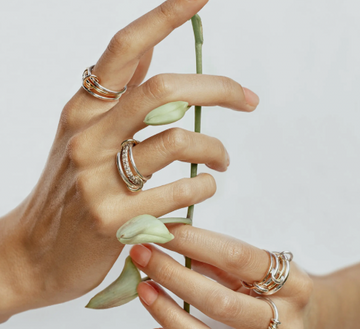
Stacking changes the equation. The combined width of an engagement ring and wedding band can create pressure at the base of the finger even when each ring feels comfortable alone. A curved or contoured wedding band may sit around a center setting, while a straight band may leave a gap or press against the engagement ring. Bring the ring you plan to wear most often when trying on a wedding band, or ask to compare a similar sample during a consultation.
Thickness influences how high the ring sits and how it interacts with objects. A thicker shank may feel reassuringly durable, but it can be noticeable when you grip a steering wheel or hold a tool. A thinner band may disappear on the hand, but its suitability depends on the design, metal, stones, and intended wear. A jeweler can help balance the look you want with an appropriate construction rather than treating a single measurement as a rule.
Why does ring size matter as much as the profile?
The right edge profile cannot rescue a ring that is too tight or too loose. A tight ring can create pressure at the finger’s base and make any edge feel more prominent. A loose ring may spin, expose the side of a setting, or rub as it moves. Finger size can also change with temperature, activity, and time of day, so a fitting should account for how the ring will be worn in real life.
GIA recommends having a jeweler measure ring size with finger gauges and considering the knuckle, band width, and hand on which the ring will be worn. Its ring size guide also explains why string and paper measurements can be unreliable. That is especially relevant for a wide band or a ring that must pass over a larger knuckle.
During a fitting, the ring should slide over the knuckle with modest resistance and rest securely without creating a painful indentation. It should not feel trapped, and it should not fall off when you relax your hand. If you are between sizes, the best choice may depend on the band’s width, interior shape, and whether you expect to wear it beside another ring.
How do metal, finish, and settings influence comfort?
Metal affects weight, color, durability, and how the finished ring feels in proportion to its design. A dense metal can make a substantial band feel more noticeable, while a lighter construction may feel less present. The important question is not whether one metal is universally more comfortable, but whether the chosen metal and construction suit your preferred scale and daily routine.
Surface finish can change the first impression of a ring. A high-polish surface may feel smooth when it is newly finished. Brushed or satin surfaces create a different visual texture. Any ring can collect scratches or show signs of wear over time, so think about whether you prefer a finish that blends changes into the design or one that emphasizes a bright, reflective look.
Stone settings and decorative details also deserve a movement test. Pavé, channel, milgrain, engraving, and raised settings can add character, but the side of the ring should not create an irritating point where it meets the next finger. Inspect the underside of the setting and the transition into the shank. A custom design can often be adjusted in this area, which is one reason a fitting conversation should happen before the final specifications are set.
If you are combining rings, look for a deliberate relationship between the profiles. Matching a rounded band with a rounded engagement-ring shank may create a soft visual flow. Pairing a flat band with a more sculptural ring can create contrast. Either approach can work when the contact points, height, and fit are considered together.
What should you consider if you work with your hands?
Daily routine should guide your choice. Someone who types, cooks, gardens, plays an instrument, works with tools, or exercises may notice different pressure points than someone who wears a ring mainly for special occasions. The right design should feel appropriate for the way you actually use your hands, not an imagined version of your lifestyle.
Before choosing a band, make a short list of the activities that matter most:
- Identify when you wear rings for the longest stretches, such as workdays, travel, or active weekends.
- Note whether you are sensitive to pressure between adjacent fingers or to contact at the base of the finger.
- Decide whether the ring must stack with an engagement ring, anniversary band, or other jewelry.
- Try comparable widths and profiles while bending your fingers, gripping an object, and resting your hand on a surface.
- Ask what care, inspection, resizing, and refinishing options are appropriate for the selected design.
For hands-on work, a lower-profile setting and smoothly finished edges may feel less intrusive, but the right choice still depends on the individual design. Some people prefer to remove fine jewelry for certain activities, while others want a band intended for frequent wear. Be candid with your jeweler about how often you plan to keep the ring on.
Explore custom ring design for a profile tailored to your everyday wear
How can a custom ring improve the fit?
Custom design is useful when off-the-shelf proportions do not solve the comfort question. Instead of choosing a profile in isolation, you can discuss the full relationship between the band, center setting, finger shape, ring size, and future stack. A custom jeweler can help you compare samples and decide where to use a rounded transition, a bevel, a contour, or a particular interior shape. Kravit’s custom ring builder is another place to begin exploring the design process.
A consultation can also clarify tradeoffs. A very slim band may create the delicate appearance you want, while a slightly broader shank may provide a better visual balance for a larger center stone. A straight wedding band may offer flexibility for future stacking, while a contoured design may sit closer to a specific engagement ring. Comfort, appearance, wear, and service considerations should be discussed together.
Bring reference photos if you have them, but also describe what you do not like. A specific concern is more actionable than simply asking for a comfort-fit ring.
For example, tell your jeweler if you do not want a corner pressing into your next finger.
If you already own a ring that feels good, bring it so its width, curvature, and fit can serve as a useful reference. If a ring feels uncomfortable, explain when the discomfort occurs and whether it is caused by pressure, rotation, catching, or the knuckle.
Custom ring design does not mean every detail must be decided at once. The first conversation can narrow the profile, width, metal, setting height, and stacking direction. From there, the design can be refined around the wearer’s priorities and the intended use of the ring.
What is the best way to compare comfortable rings in person?
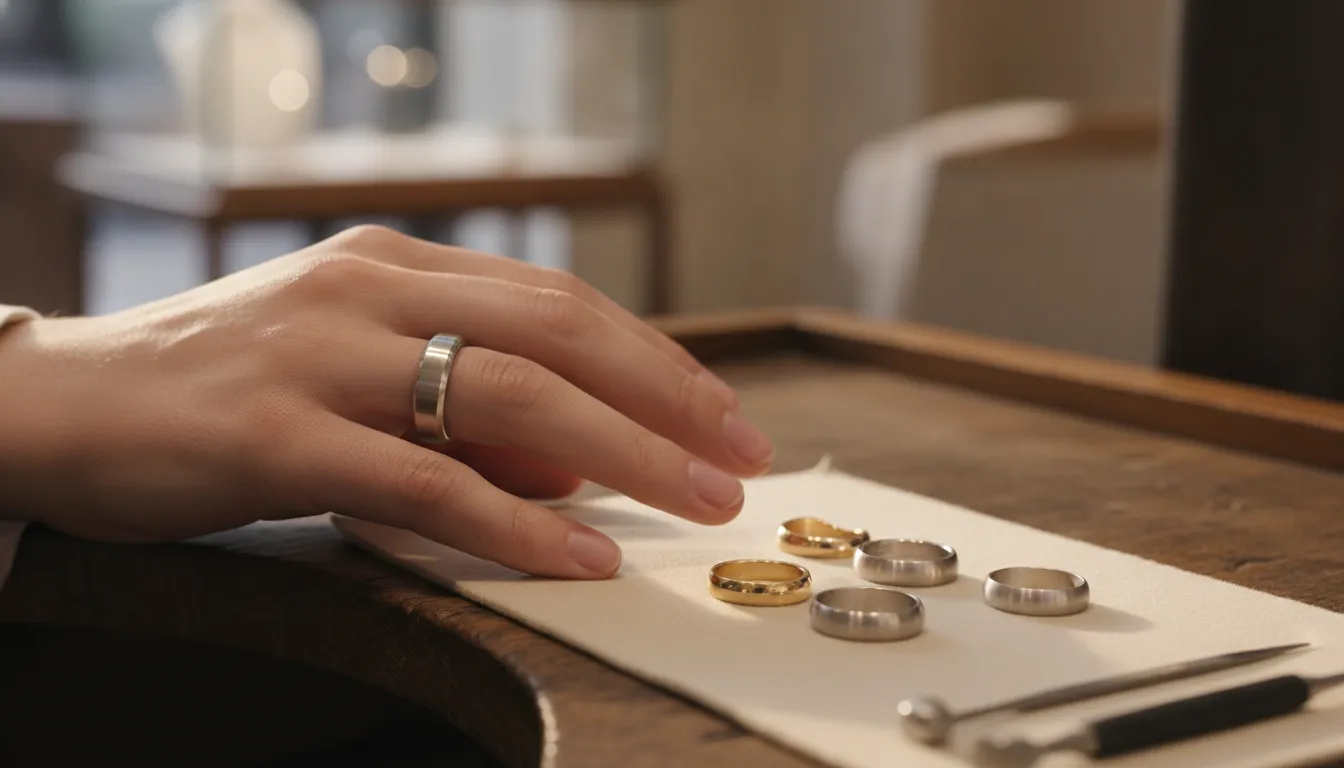
Try on more than one profile and compare them under the same conditions. Start with a size that feels appropriate, then look at a narrow, medium, and wider example if available. Compare a rounded edge with a defined or beveled edge. Wear the samples long enough to notice whether your attention keeps returning to a pressure point.
Use this fitting checklist:
- Can the ring pass over the knuckle without forcing it?
- Does it rest securely when your hand is relaxed and when your fingers point downward?
- Do the edge and neighboring ring create pressure between your fingers?
- Does the ring rotate enough to move a setting out of position?
- Can you close your hand, type, and hold a small object comfortably?
- Does the band’s height work with your engagement ring or planned stack?
- Do the underside and setting edges feel smooth when you run a finger over them?
A short in-store fitting can reveal more than a long online search because you can compare proportions directly. It is also a chance to ask about sizing, future adjustments, cleaning, inspection, and how the design is expected to wear. If you are shopping for a couple, each person can test their own band while discussing how the two rings will be worn together.
When should you book a ring-comfort consultation?
Book a consultation before you finalize a wedding band, engagement-ring setting, or custom ring specification if comfort is a priority. It is especially helpful when you have a larger knuckle, prefer a wide band, or plan to stack rings. It can also help if you have had a previous ring spin or pinch, or are unsure how a profile will fit your routine.
At Kravit Jewelers in Oceanside, Long Island, a conversation about comfort can cover profile, width, fit, stacking, metal, and the practical details of the design you are considering. The team can help you compare options and determine whether a custom approach is appropriate for your goals. Bring your existing engagement ring or a favorite band if you want the new ring evaluated as part of a stack. You can also review the Long Island custom engagement ring builder before your visit.
Book a ring-fitting consultation at Kravit Jewelers: call (516) 766-3855
Frequently asked questions about how to choose a comfortable ring
What is the most comfortable ring edge?
A rounded edge is often a comfortable starting point because it softens the transition at the sides of the band. However, comfort depends on the full design, including the interior contour, width, thickness, size, and how the ring is worn with other jewelry. Try the actual proportions rather than relying on the profile name alone.
Is a comfort-fit ring better than a standard-fit ring?
A comfort-fit interior can feel smoother as the ring passes over the knuckle and may reduce the sensation of a flat band pressing against the finger. It is not automatically better for every wearer. A comfort-fit ring still needs to be sized securely, and a rounded interior may affect how the ring rotates or sits beside another band.
Should a wedding band be rounded or flat?
Choose based on the way you want the band to feel and how it will stack. Rounded profiles can provide softer contact, while flatter or more defined profiles can create a structured look and may pair well with certain engagement-ring shapes. Compare both while moving your hand and wearing the engagement ring if you have one.
Does a wider ring need a larger size?
A wider band can feel more snug because it covers more of the finger, but the correct adjustment depends on the band’s construction, interior shape, finger, and how it will be worn. Do not automatically size up. Have the intended width measured or try on a comparable sample with a jeweler.
How do I stop a ring from spinning?
Spinning can be related to size, the weight of the setting, the finger’s shape, or the band’s proportions. A secure fitting is the first step. A jeweler can assess whether a different size, profile, shank design, stack relationship, or another adjustment would help. Avoid making a permanent change before identifying why the ring moves.
Can a custom jeweler design a ring for comfort?
Yes. A custom consultation can address the interior contour, edge profile, width, thickness, setting height, and relationship to other rings as one design. Share your daily activities and any previous fit problems so the design conversation reflects how you plan to wear the ring.
Find your comfortable ring profile
The most comfortable ring is the one whose proportions suit your finger, routine, and jewelry wardrobe. Compare edge profiles in person, pay attention to the interior fit, and consider the band’s width and stacking relationship before committing. A thoughtful fitting can help you choose a ring that feels natural as well as beautiful.
Call (516) 766-3855 to book your ring-comfort consultation with Kravit Jewelers or contact the Oceanside showroom.


