



Luxury watch care between services is mostly about a few careful habits: handle the watch gently, keep it away from avoidable hazards, and notice changes rather than attempting a repair. A consistent routine can help protect the exterior and make it easier to describe a concern when you seek professional advice. Water resistance, materials, movement and manufacturer guidance differ, so use the instructions for your particular watch as your first reference.
What is a sensible everyday routine?
Build care around the moments when the watch is handled. Before putting it on, make sure your hands are clean and dry. Fasten the clasp securely, and hold the watch by its case or bracelet rather than pulling on the crown or a small control. When removing it, set it on a stable, soft surface. A sink ledge, hard countertop or table edge creates an unnecessary chance of a fall.
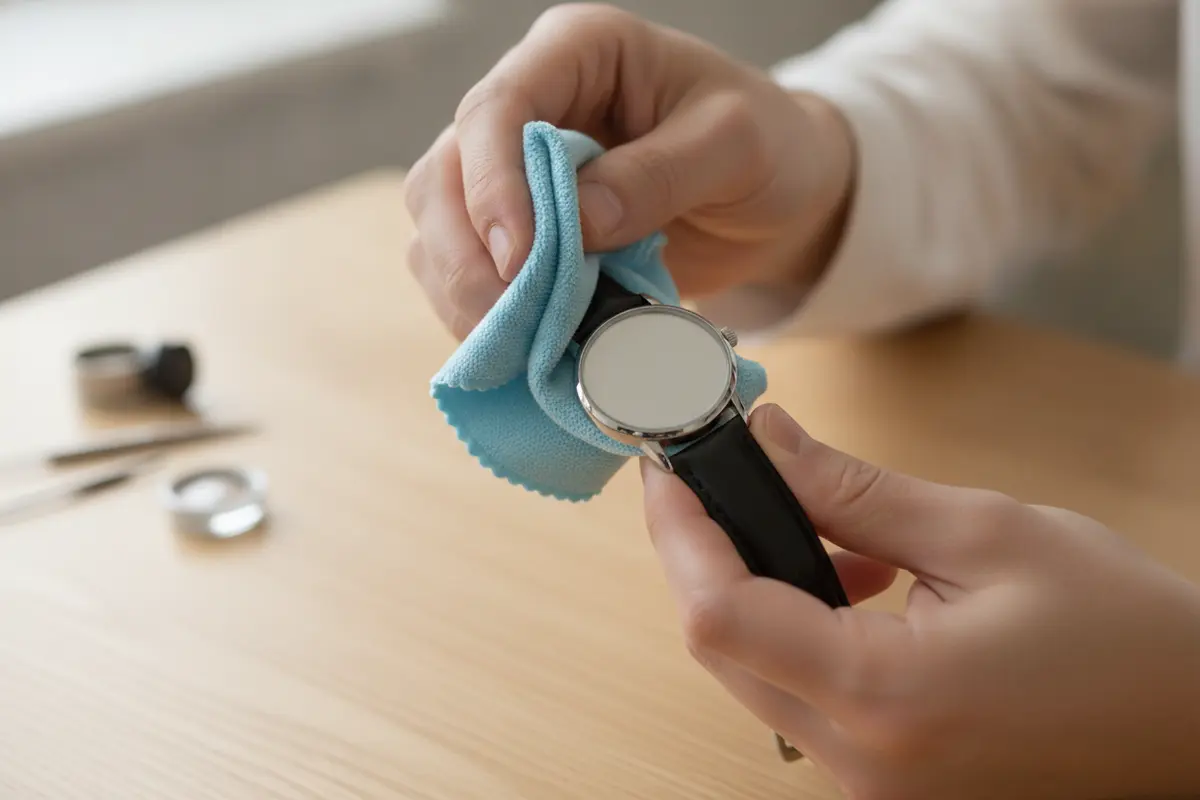
After wearing the watch, use a clean, soft, dry cloth to lift fingerprints and light surface residue. Wipe gently; firm pressure is not needed. This is a simple exterior routine, not a way to remove scratches or clean inside the case. If residue is caught in a narrow gap, do not push a pin, toothpick or metal tool into it. A small mark is preferable to damage caused by an improvised tool.
It can help to give the watch a brief visual check as you take it off. Look at the crystal, case, bracelet and clasp without trying to manipulate parts. If something looks newly loose, cracked or out of place, set the watch aside and arrange advice instead of wearing it until the issue is understood.
How should you handle moisture, cosmetics and temperature?
Do not infer water suitability from a watch’s appearance, price or the presence of a screw-down crown. Water resistance depends on the specific model and the condition of its seals, and the watch’s guidance sets the relevant limits. A rating is not a reason to assume that every activity or exposure is appropriate. Check the owner’s documentation for the exact watch. If the directions are missing or unclear, keep it dry and ask a qualified professional before bringing it near water.
Showering, swimming, washing dishes and using a hot tub are not interchangeable situations. Heat, soaps, pressure and repeated exposure can make a simple guess unwise. Do not test water resistance at home, and do not rely on an old rating as proof of the watch’s current condition. If water exposure occurs contrary to the instructions, explain what happened when you seek help. If you notice condensation beneath the crystal, stop using the watch and arrange an assessment promptly.
Put the watch on after applying lotion, perfume, sunscreen or hair products, and remove it before using household cleaners or solvents. These substances can leave residue and may not suit every material or finish. If a splash reaches the exterior, wipe it gently with a dry cloth. Do not rinse the watch to remove a product unless its documentation specifically allows that cleaning method and you are confident about its condition.
Keep the watch away from direct heat and prolonged strong sunlight. Avoid leaving it on a dashboard, beside a radiator or near equipment that may expose it to strong magnetic fields. The effects can vary with construction and movement, so do not attempt to diagnose a timekeeping change based on one exposure. Note what happened and ask a professional if the watch behaves differently afterward.
Where is the safest place to store a watch?
Choose a dry, clean place where the watch cannot slide, fall or rub against other objects. A watch box or a soft-lined drawer can provide a stable home between wears. If you keep several pieces together, give each one its own space. Metal edges, gemstones, clasps and loose accessories can scratch or mark neighboring surfaces when they move against one another.
Avoid a bathroom counter or another location that is routinely damp, and do not leave the watch where children, pets or visitors may handle it unintentionally. Keep removed bracelet links, papers and accessories together in a place you can find. Documentation is especially useful when care depends on the model. If you inherited the watch or no longer have its papers, record what you know about its make, model and history without guessing at specifications.
Storage choices may also depend on the movement. Some watches have different winding or setting instructions, while others may not need the same routine. Follow the specific manual rather than applying a general rule to every watch. If you are unsure how to store or operate a watch that will be unworn for a while, ask for guidance before experimenting.
Which care choices depend on the watch?
There is no single home-care instruction that fits every luxury watch. Case and crystal materials, bracelet construction, seals, movement and manufacturer recommendations can all affect what is appropriate. Use this comparison as a cautious starting point, not as a substitute for the watch’s documentation or a condition assessment.
| Situation | Safer first step | When to seek advice |
|---|---|---|
| Fingerprints after wear | Gently wipe accessible exterior surfaces with a clean, soft, dry cloth. | If residue persists or the finish appears changed. |
| Considering water exposure | Check the model-specific instructions; keep the watch dry if uncertain. | If the instructions or current seal condition are unclear. |
| Debris near a case edge | Wipe only what is easily accessible; do not insert a tool. | If debris is trapped in a gap or beneath the crystal. |
| Watch will be stored | Use a dry, stable, separate place and follow its manual. | If it stops or needs an unfamiliar winding or setting step. |
| Impact, moisture or visible damage | Stop using the affected feature and avoid trying a fix. | Arrange an assessment and describe what occurred. |
For broader background on time measurement and standards, the National Institute of Standards and Technology is an authoritative reference; its general information is not a substitute for model-specific care instructions.
What should you avoid doing at home?
Do not open the case, adjust the movement internally or apply household polish. Avoid abrasive cloths, polishing compounds, ultrasonic equipment and improvised tools unless a qualified professional has confirmed that a specific method is suitable for your particular watch. Materials and construction vary, and a treatment that seems harmless on one surface can be inappropriate for another.
Do not force a crown, pusher, clasp or bracelet link that resists. If a control will not move normally, stop rather than applying more pressure. Do not repeatedly wind or reset a watch when the instructions are unclear. Follow its manual, and seek help if the watch resists, stops again or behaves differently than expected.
Online advice can be useful for general orientation, but it may describe another model or condition. Before following a cleaning or operating tip, check whether it matches the documentation for your watch. If it involves opening, polishing, regulating, testing or replacing a part, it is safer to ask a professional who can inspect the watch and explain the appropriate next step.
How can you protect a watch while traveling?
Travel adds handling and storage changes, so decide where the watch will be kept before you leave home. When it is not being worn, place it in a padded watch case or a separate compartment where it cannot move freely. Do not put it loose in a pocket or bag with keys, coins, chargers or other jewelry. Keep the watch away from the edge of a hotel sink and avoid leaving it in direct sun or inside a hot vehicle.
If you take the watch off at security or during a change of activity, put it somewhere secure before continuing. Avoid setting it on a public counter while gathering your belongings. If the watch is exposed to rain or an unexpected splash, dry the exterior gently and consult its instructions; do not assume that a quick rinse or a blast of warm air is safe. Note any concern that appears during the trip so you can describe it accurately afterward.
For a long journey, carry the instruction booklet or a saved copy of the relevant model guidance if you expect to need it. Keep repair paperwork and other identifying details separate from the watch itself. These precautions are simple, but they make it easier to store the watch consistently and to explain a change without relying on memory.
Plan an in-person visit to discuss your watch
Which changes should prompt professional attention?
Arrange an assessment if you notice condensation under the crystal, a cracked crystal, a loose or damaged bracelet, a clasp that does not secure, or a crown that no longer operates normally. A sudden or persistent change in timekeeping can also be a reason to ask for advice. These signs do not identify a specific fault, but they are good reasons not to guess at a fix.
Explain if the watch was dropped, struck, exposed to water against its instructions or caught on something. Do not keep wearing it simply to see whether the symptom gets worse. If the watch feels unstable on the wrist, set it aside safely. If moisture is visible under the crystal, avoid operating the controls while you arrange help.
Not every mark requires restoration, and not every change means that a particular component has failed. An examination helps determine what is happening and whether any work is recommended. Kravit Jewelers’ watch repair expertise is a place to begin a conversation about assessment and recommendations. You can also review information about visiting the Oceanside showroom before planning an in-person conversation.
How can you prepare for a repair consultation?
A few simple notes can make the conversation more useful. Bring the watch and any available documentation or accessories that relate to the question. Write down when you first noticed the issue, whether it happens every time, and what the watch was doing. Mention any recent impact, moisture exposure or change in how it was stored.
Describe what you observed rather than trying to name a cause. For example, say that the watch stopped overnight, that the clasp no longer stays closed, or that a hazy patch appeared beneath the crystal after a particular event. Include whether the change was sudden or gradual. A clear account helps the professional understand the concern without treating a guess as a diagnosis.
Before the appointment, gather questions you want answered. You might ask what assessment is appropriate, what the inspection can determine, what work is being recommended and whether the watch should be left for further evaluation. Ask for an explanation of options before authorizing work. Recommendations and service needs vary with the watch and its condition, so the next steps follow an examination rather than a universal schedule.
If you are visiting from outside Oceanside, check the visit information and plan how to carry the watch securely. Keep it in a case or a padded pouch while traveling, and avoid placing it loose in a bag with keys or other jewelry. You can also explore the store’s timepiece selection separately, but product information should not be used as a substitute for service advice about your own watch.
Learn about arranging a watch repair consultation
How can you make a simple care plan?
A short written routine can help you stay consistent without turning watch care into a complicated project. Keep the manual and any service paperwork together. Note the model details and the date of the most recent professional service if known. After wear, wipe the exterior gently and return it to a dry, separate storage place. Make a note of any change rather than repeatedly testing the watch.
For a watch worn often, choose one regular moment—such as when you remove it at night—to check that the clasp is secure, the exterior looks as expected and the storage spot is clear. For a watch worn occasionally, check the instructions before operating its crown or controls after storage. These small steps are not a substitute for professional service, but they help avoid casual handling and make changes easier to identify.
Keep the routine flexible. A watch used in a dusty workplace or on frequent trips may need different attention from one worn only for special occasions. Let the manual, the watch’s condition and professional recommendations guide any adjustments. Do not create a cleaning schedule that requires water or products unless the manufacturer’s guidance clearly permits them.
Frequently asked questions
Can I clean my luxury watch with soap and water?
Do not use water or soap unless the documentation for that specific watch confirms an appropriate method and you have no reason to suspect a problem with its condition. For light fingerprints, a clean, soft, dry cloth is a cautious option. Ask a professional if you are uncertain.
Should I wind a watch that has stopped?
Follow the instructions for that watch and do not force the crown. If it resists, feels unusual or the watch continues to stop, seek professional guidance instead of trying different winding or setting methods.
How often should a luxury watch be assessed?
There is no single interval that applies to every watch. Follow the manufacturer’s recommendations and consider the watch’s use, condition and known history. Arrange advice sooner if you notice damage, a change in operation or possible moisture exposure.
Can I polish a scratch at home?
Avoid household polish and abrasive materials. A professional can inspect the surface and explain suitable options, if any. A mark does not automatically need to be removed.
What is a sensible next step?
Use a gentle routine, rely on watch-specific instructions and seek professional advice when you notice a change or are unsure about a care step. An assessment can help you understand the watch’s condition and decide on an appropriate way forward.


