




A well-chosen travel jewelry case helps keep favorite pieces organized and reduces the chance of tangles, scratches, or misplaced backs while you are away. The best travel jewelry case is not necessarily the largest or most elaborate. It is the one with compartments suited to the pieces you intend to bring, a secure closure, and a size that fits your packing habits.
Explore fine jewelry for your next trip
What should a travel jewelry case protect against?
Travel adds movement and pressure. A necklace can knot when it shifts against other pieces. Earrings can separate from their backs. A ring can rub against a harder item in a suitcase. A case with individual storage spaces helps limit contact and makes it easier to see what you packed.
Storage is not a guarantee against damage. Keep jewelry away from toiletries, liquids, and sharp objects, and avoid placing a heavy item on top of the case. For a valuable or especially delicate piece, consider whether it is necessary to bring it at all. A small edit before departure can simplify both packing and care.
Which features matter when choosing a travel jewelry case?
Start with the jewelry you wear most often on trips. Look at the types and number of pieces, then compare a case’s layout against that list rather than buying based only on appearance.
| Feature | Useful for | What to check |
|---|---|---|
| Necklace hooks or slots | Chains and pendants | Can each chain be secured separately? |
| Ring rolls | Rings and bands | Do the spaces hold rings without forcing them? |
| Earring panel or holders | Studs and small drops | Can pairs and backs stay together? |
| Divided compartments | Bracelets and larger pieces | Are dividers deep enough to limit contact? |
| Secure closure | All packed pieces | Does it close firmly without squeezing contents? |
Soft lining can cushion jewelry, while a firm outer structure can help the case keep its shape in a bag. Check that the interior does not have loose threads, rough seams, or exposed hardware that could catch on a chain. The case should close without pressing directly on a raised setting or other delicate detail.
How do you match a case to the jewelry you are bringing?
Make a short packing list before choosing a case. Include each piece by type: for example, two pairs of earrings, one chain, a bracelet, and a ring. Then check whether the case has separate spaces for each. A case that looks compact may be practical for a few small items but frustrating if it has no place to secure a necklace.
- For necklaces: Look for hooks or dedicated slots that keep chains apart. Fasten each clasp before securing it.
- For earrings: Use paired holders where possible, and keep backs attached or in a small enclosed section.
- For rings: Choose ring rolls or individual divisions so rings do not knock together.
- For bracelets: Check the compartment length and depth, especially for a rigid bangle.
Think about how you travel, too. A case meant to sit on a dresser may have a different shape from one designed to fit in a small handbag. Choose an exterior that suits your luggage and a layout you can use without unpacking every item at once. If you prefer a necklace for a trip, you can compare the shape and length of your chain with a selection of chains before setting up a dedicated space for it.
How should you pack jewelry in a travel case?
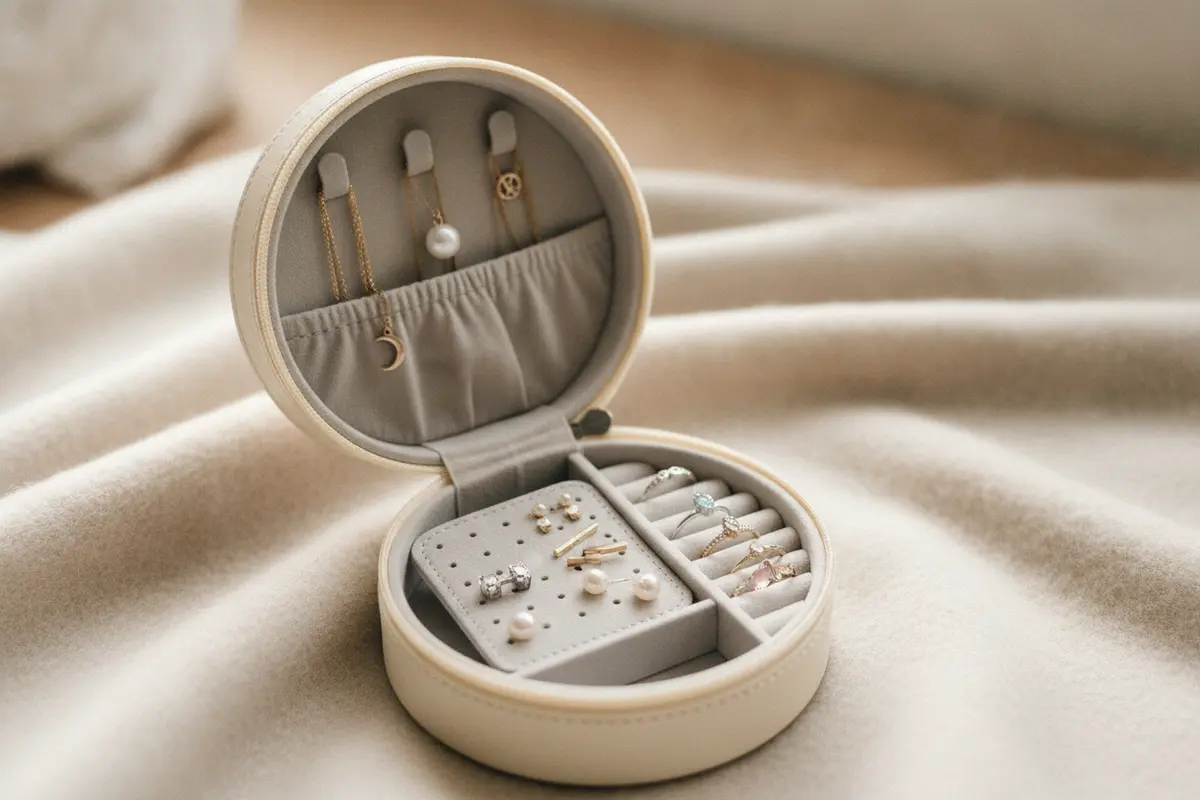
Begin with clean, dry hands and a clear surface. Lay out only the pieces you have decided to bring. Check each clasp and earring back, then place each item in its designated space. Keep chains separate, secure their clasps, and avoid winding them tightly around other jewelry.
- Inspect the case interior for grit, loose fibers, or rough edges.
- Fasten necklace clasps and place chains in separate holders.
- Secure earrings in pairs and place loose backs in a closed compartment.
- Fit rings into ring rolls or separate slots without forcing them.
- Close the case gently and confirm that no piece is caught in the seam.
For additional travel packing guidance, the Gemological Institute of America recommends placing jewelry in separate plastic bags while traveling. This can be a simple backup for separating items, but use a case layout that fits your belongings and protects them from pressure. Read the GIA’s tips for traveling with jewelry.
How can you plan a packing list by trip length and occasion?
The right case depends partly on how many changes of clothing and occasions are on the itinerary. A short overnight stay may call for only the pieces you wear daily. A longer trip with a formal event may require a second pair of earrings or a different necklace. Thinking through those moments in advance helps you avoid packing extras “just in case” that add clutter without serving a purpose.
Try grouping the list by use, not by jewelry type alone. Write down the everyday pieces, any occasion-specific pieces, and the items you will wear in transit. Then remove duplicates that do the same job. A simple chain that works with several outfits may be more useful than several necklaces that each suit only one look. If you plan to bring a pendant, check whether its bail fits the chain and whether both items have room to sit separately in the case.
Next, assign each piece to a storage location. A case should have a realistic amount of room for the list, not just enough space if every compartment is packed tightly. Leave a little clearance around pieces with protruding settings or larger clasps. If you cannot close the case easily with the planned contents, remove an item or choose a larger layout rather than pressing down on the contents.
What case shape and closure suit your luggage?
A case that works on a bedroom dresser may be awkward in a carry-on or small handbag. Before choosing, consider where it will travel and how you will reach it. A compact, flat design can fit neatly among clothing, while a more structured case may be easier to open and organize once you arrive. Neither format is automatically better: the useful choice is the one that can stay closed, protected from pressure, and easy to locate in your bag.
Check the closure with the case empty and again with the pieces inside. A zipper should move smoothly without catching on the lining. A snap or clasp should close securely without requiring force. Look at the edge where the lid meets the base: a chain or earring back should not be able to slip into that seam. If the design has removable trays, confirm that they sit flat and do not shift when the case is moved gently.
Also consider the outside material and care instructions. A delicate finish may need to be kept away from rough luggage surfaces, while fabric can collect dust or fibers. These details do not determine whether a case is suitable on their own, but they affect how well it fits your routine and how likely you are to use it consistently.
Should you bring every piece you might wear?
Usually, a smaller selection is easier to manage. Choose pieces that work with the clothing and occasions you expect, and leave sentimental or delicate jewelry at home if you do not need it. The fewer items you pack, the easier it is to keep track of them and return them to their places at the end of the day.
Consider how you will store the case at your destination. Keep it closed when not in use and choose a consistent place for it. Avoid leaving jewelry loose on a bathroom counter or in a pocket. If you use a hotel safe, ensure the case fits and keep a record of what you have stored.
It may help to make a brief inventory before you leave. Note what is in the case and take a private reference photo if that suits your needs. This is not a substitute for secure storage, but it gives you a straightforward way to check that each item is returned to its compartment after wearing. When you take something off, put it directly back rather than setting it down temporarily on a counter or bedside table.
What should you avoid in a travel jewelry case?
A crowded compartment can press pieces together. Do not force a bulky bracelet into a small space or stack items in a way that lets hard surfaces rub. Avoid a case with an unreliable clasp or lining that catches on fine chains. If the case is damp, dusty, or damaged, choose a cleaner and more secure storage option.
Also avoid assuming that a case makes every piece suitable for travel. A piece with a loose clasp or a setting that needs attention may be better left at home until it has been assessed. Do not attempt a repair on the road with household tools; seek appropriate professional advice instead.
How do you adjust storage for different jewelry shapes?
Not every piece fits a standard compartment in the same way. A long chain needs a different arrangement from a short pendant necklace, and a rigid bangle needs a different space from a flexible bracelet. Think about the piece’s shape when testing a case rather than relying only on the labels on its compartments.
For a fine chain, avoid sharp bends and crowded loops. Secure the clasp, place the chain in its intended holder, and let it rest without tension. If a holder forces a tight fold, use another suitable compartment or a separate small pouch inside the case. Keep that pouch closed and isolated from earrings or other pieces that might catch in the chain.
For earrings, check the post and back together before packing. Small backs can disappear easily, so a covered pocket or a paired holder is useful. For drop earrings, consider whether the design can lie flat without bending or snagging. Rings should sit in slots that hold them without squeezing the band. A ring with a prominent setting should not be placed where the lid presses against it.
Bracelets and bangles can be especially awkward in a compact case. Measure the available compartment against the item’s overall shape, and do not bend a rigid piece to make it fit. A watch or bracelet with a clasp should be stored so the clasp does not scrape another item. If no compartment accommodates a piece comfortably, consider leaving it at home or choosing another storage arrangement.
What should you do when you arrive and during the trip?
On arrival, choose one consistent place for the closed case, away from sinks, open windows, and busy surfaces. Unpack only the pieces you plan to wear that day. Return each item to its assigned place when you take it off, and close the case before moving it. A predictable routine is often more useful than a complicated organizing system because it reduces the number of places you need to check.
Before leaving the room, take a quick look at the case and the surface where you got ready. Check that earrings have their backs, chains are secured, and rings are not left beside toiletries. If you move the case between a suitcase and a handbag, confirm that the closure is fully engaged and that nothing is caught at the edge. Keep it within your personal belongings rather than loose in a shared bag pocket.
At the end of the trip, inspect each piece before returning it to your regular storage. Look for a clasp that has opened or an earring back that is loose. If something seems different from before, set it aside rather than wearing it until you can determine whether it needs attention.
When should you ask a jeweler about a piece before traveling?
If a clasp does not close, a stone appears loose, or a chain has a damaged link, consider getting guidance before packing the piece. An in-person jeweler can look at the item and discuss appropriate next steps. For jewelry that needs attention, you can learn about Kravit’s in-store options and contact the store to ask what is suitable for your situation.
A case selection can also be easier when you know the dimensions and shapes of your jewelry. Bring the pieces you expect to carry or describe them clearly when asking for guidance. Kravit Jewelers has served Oceanside and Long Island since 1927 as a family-owned jeweler; a conversation can help you consider how to care for pieces before a trip without assuming that every item needs the same solution.
For example, if an earring back has been replaced or a clasp feels different than usual, describe what you noticed and when it happens. If the jewelry has sentimental value or a delicate design, mention that before seeking guidance so the discussion can focus on the piece’s condition and the care steps that make sense. Avoid describing a concern as a confirmed defect until it has been assessed. The aim is to make an informed choice about whether the piece belongs in your travel set, not to assume every concern requires the same work.
Travel is also a useful moment to review how each item is stored at home. A chain that tangles easily in a drawer may need its own storage habit after the trip, while earrings with tiny backs may benefit from a dedicated closed compartment. Select jewelry storage that suits how you use the pieces day to day, and keep pieces clean and dry before putting them away.
Browse fine jewelry and plan your travel selection
What should you remember when choosing a travel jewelry case?
Choose storage around the pieces you will actually bring. Separate chains, earrings, rings, and bracelets; check the lining and closure; and pack with enough room to avoid pressure. A thoughtful routine helps make jewelry easier to find and care for throughout your trip.


