


Knowing how to test gold can help you decide what to ask before selling or keeping a piece. At home, you can look for clues such as a hallmark and observe how an item behaves, but those checks do not establish its exact purity or market value. Avoid methods that scratch, heat, or expose jewelry to chemicals. A professional evaluation is the better next step when the answer matters.
Ask Kravit Jewelers about a gold evaluation
What does a gold hallmark tell you?
A hallmark is a stamp or mark intended to indicate metal fineness or a manufacturer. On jewelry, you may see numbers such as 375, 585, or 750, or karat marks such as 9K, 14K, or 18K. These marks can be useful clues, but they are not a stand-alone proof. A stamp can be worn, difficult to read, misleading, or inconsistent with the item’s actual composition.
Look first at places where a mark is commonly placed, such as the inside of a ring or near a chain clasp. Use good light and, if available, a magnifier. Do not scrape away dirt or polish aggressively to reveal a mark; that can damage a finish or remove material. Photograph the mark and note the item’s weight and any visible wear. A mark indicates what the piece claims to be, not whether every component has the same metal content.
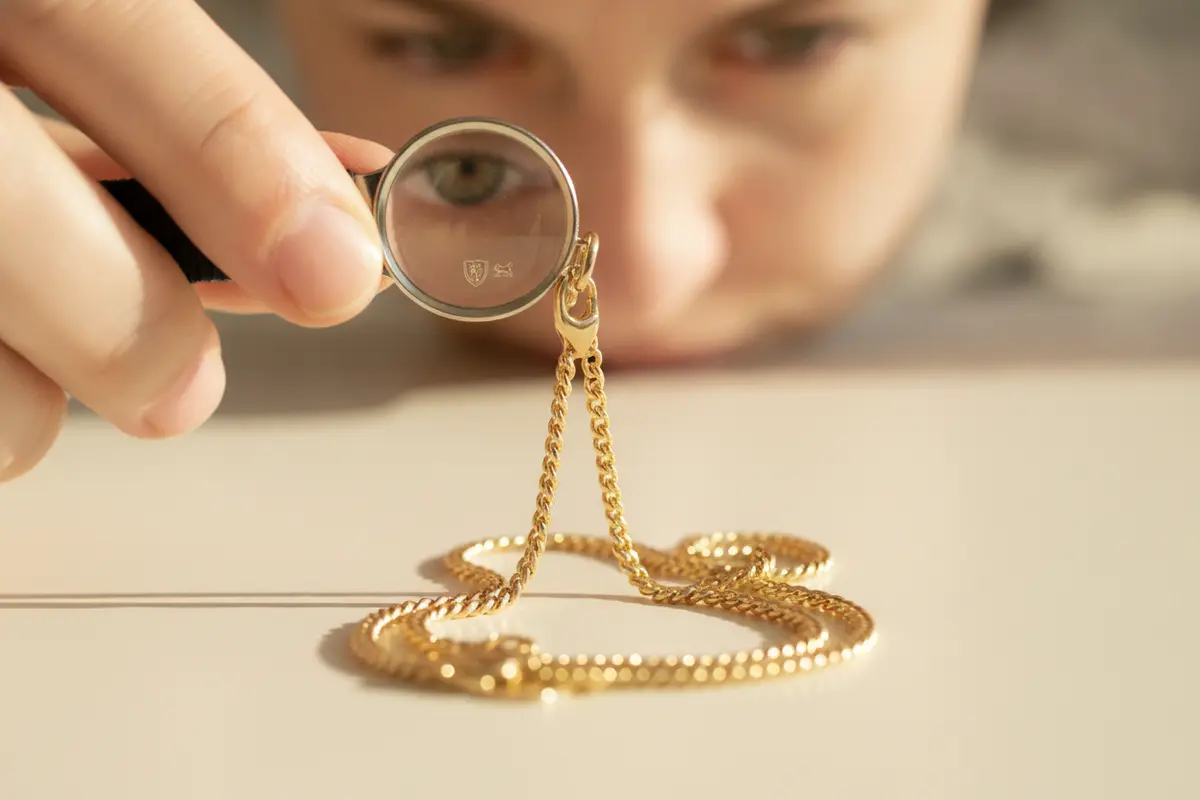
Construction matters too. A clasp, spring, solder joint, or decorative element may differ from the main body of a piece. Gold-plated and gold-filled items can carry marks that refer to the surface or construction rather than solid gold throughout. If a mark is absent, that alone does not prove an item is not gold; marks may be missing or illegible.
Which at-home checks are useful, and what can they show?
At-home checks are best treated as screening observations. They can help you form questions, not deliver a definitive verdict. The table below compares common checks and their limits.
| Check | What it may suggest | Important limitation |
|---|---|---|
| Read the hallmark | The stated fineness or karat marking | Marks can be worn, false, or apply only to a component or surface |
| Inspect color and wear | Visible differences in color or exposed base metal | Lighting, alloys, plating, and repairs can affect appearance |
| Use a magnet nearby | A strong attraction may indicate magnetic material in some component | Many non-gold metals are not magnetic, and clasps or parts can behave differently |
| Compare weight and feel | A rough comparison with a known similar item | Size, hollow construction, alloy, and design make comparisons unreliable |
| Professional testing | Evidence about composition from appropriate testing | Method and interpretation depend on the item; ask what was tested |
Before trying any check, decide what information you actually need. If you only want to document an inherited piece, a photograph of its mark and condition may be enough for now. If you are deciding whether to sell, insure, repair, or pass it on, a home observation cannot answer every question. The important distinction is between evidence that prompts further examination and evidence that supports a confident conclusion.
Can a magnet test tell you if gold is real?
Pure gold is not attracted to an ordinary magnet, so a strong pull can be a reason to investigate. But a lack of attraction does not establish that a piece is gold. Copper, brass, and many other materials are also not strongly magnetic. A chain may contain a steel spring in its clasp, while a piece may be plated over a nonmagnetic base metal. Test the item gently with a small magnet and do not let it snap against the jewelry.
Interpret the result narrowly: attraction tells you that some magnetic material may be present at that location. It does not measure gold content. No attraction only means the magnet did not reveal a magnetic component in the area you tested. Do not use this result to set a selling price or discard an item.
For a chain, you can observe the clasp and links separately without pulling or bending them. If only one small area reacts, that may point to a component rather than the whole piece. Record which spot responded and tell the evaluator what you observed. A magnet is a simple screening tool, not a substitute for examining the alloy or construction.
What can color, weight, and wear reveal?
Color can raise questions, particularly where a worn edge exposes a different-looking layer. Yet gold alloys vary in tone, and plating can be applied over different metals. Tarnish, dirt, solder, and previous repairs can also change appearance. A visual inspection is not enough to determine fineness.
Weight is similarly easy to misread. A solid item may feel heavier than a hollow one of similar dimensions, but the comparison depends on design, dimensions, and alloy. A household scale can provide a rough measurement for your notes, not a reliable purity test. Avoid online formulas that assume an object is solid, uniform, and a known volume; jewelry rarely offers enough certainty for those assumptions.
Wear patterns can be useful to document, but they do not tell the complete story. Look at high-contact edges, the underside of a ring, and spots around a clasp where a surface layer may have rubbed away. Avoid probing a suspected worn area with a pin or blade. Doing so can enlarge a mark, loosen a setting, or damage a finish while still revealing little about the rest of the piece.
If you have several pieces, keep each one separate and record visible marks, approximate weight, and condition. Do not combine broken items or remove stones before an evaluation. The item’s design and components may affect how a professional examines it.
Why should you avoid scratch, acid, and heat tests?
Some guides describe rubbing jewelry on a test stone, applying testing acid, or using heat. These methods can damage an item, create a safety hazard, or produce a result that is easy to misinterpret. A scratch can leave a permanent mark and may test only a surface layer. Chemicals require appropriate handling and still need skilled interpretation. Heating jewelry can damage gemstones, settings, solder, or finishes and can cause burns.
The National Pawnbrokers Association describes the scratch test as a commonly used over-the-counter approach to testing gold. That does not make it suitable for a valuable or sentimental item, or prove that a do-it-yourself result is conclusive. For guidance on that method, see the association’s overview of gold testing techniques. If preserving the piece matters, leave invasive testing to an appropriately equipped professional.
Avoid improvised variations as well. Rubbing jewelry on ceramic, applying household cleaners, toothpaste, vinegar, or bleach, and comparing how quickly a surface changes are not dependable ways to establish fineness. These materials can leave residue or affect a finish, and the result may reflect plating, dirt, or a repair rather than the underlying metal. Do not combine chemicals or test pieces while they are being worn.
If someone has already tried an abrasive or chemical method, stop before repeating it. Rinse only if the product instructions or a qualified professional recommends it; some settings and stones need special care. Photograph the affected area and explain what was used when asking for an evaluation. That history may help the examiner distinguish a test mark from ordinary wear.
How does a professional evaluation differ from a home check?
A professional can examine the piece, consider its construction, and select a test suited to the item. Some testing methods assess surface composition, while others may offer different information; the method and what it can establish depend on the piece. Ask what was tested, whether the test could mark or affect the item, and whether findings apply to the entire piece or only a particular spot.
Gold content is only one part of an item’s potential value. Weight, condition, craftsmanship, gemstones, brand or maker, and current market conditions may matter. A hallmark by itself does not provide a quote. For an initial conversation, you can contact Kravit Jewelers about gold buying and ask what information to bring. Scope and evaluation details should be confirmed with the store before you visit.
Keep expectations measured. The amount offered, if any, depends on the item and evaluation; do not rely on an online estimate as a guaranteed offer. If you are comparing options, ask whether an evaluation is complimentary or fee-based, what happens if you decline, and how the explanation of the result will be provided.
Browse gold jewelry examples to see how designs and construction can vary; a retail listing is not a valuation of an item you own.
It can help to separate three different questions during a visit: what metal is present, how much of the item is gold, and whether the item has additional value beyond its metal content. A simple test may inform the first question without settling the second or third. Ask whether stones, non-gold components, and workmanship are considered separately, and request an explanation in plain language before deciding what to do.
What should you do before bringing gold in?
- Gather pieces separately. Keep chains, earrings, rings, and loose components in individual pouches or containers.
- Record visible details. Note readable hallmarks, approximate weight if known, condition, and any repairs or missing parts.
- Photograph marks. A clear close-up may help you explain what you observed, but do not alter the piece to make a stamp more visible.
- Bring relevant documentation. Receipts, prior appraisals, or original packaging may help provide context, though they do not replace examination.
- Ask about the process. Confirm which items can be evaluated, what testing involves, and whether there is any obligation to proceed.
Before leaving home, check that each item is secure and that small components are contained. If a clasp is loose or a stone appears unstable, avoid wearing the piece in transit. Write down any questions you want answered so the conversation covers the metal, the method of testing, and possible next steps. This is especially useful when several pieces look similar but have different marks or histories.
Do not assume that every item made of gold is within a buyer’s scope. Acceptance of coins, bars, or other forms can vary and should be confirmed in advance. If you are bringing inherited jewelry, separate items whose history or ownership needs clarification and ask what documentation is appropriate.
How can you compare evaluation options?
When deciding where to go, compare the process rather than relying on a single claimed test. A careful evaluator should explain what they examined and distinguish an observation from a confirmed finding. Consider these questions:
- Will the evaluation involve any mark, scratch, chemical, or other change to the piece?
- Is the test focused on the whole item or a specific component?
- How are stones, clasps, and non-gold parts considered?
- Will the findings and any offer be explained separately?
- Can you take the item away and decide later?
These questions help you understand the limits of the result and preserve time to compare choices. You can also ask the Oceanside team about arranging a conversation before making a trip. Kravit Jewelers has served the Long Island community since 1927 as a family-owned jeweler; confirm current evaluation scope and visit details directly.
It is also reasonable to ask how the item will be handled while it is examined and whether any components must be separated or moved. If you have a sentimental piece that you do not plan to sell, say so at the outset. That context helps frame the discussion around identification and care rather than an offer. If you are comparing more than one evaluation, keep the written notes and questions consistent so that the explanations are easier to compare.
Bring any prior paperwork as context, not as a substitute for an examination. An appraisal, receipt, or old repair record may describe a past condition or purpose that differs from the question you have today. Clarify whether you want information about metal composition, an insurance appraisal, or a potential purchase offer, since those are different kinds of assessments and may involve different processes.
There is no need to arrive with a verdict already in mind. A useful visit can begin with a question: what can be determined without changing the piece, and what uncertainty will remain? Ask the evaluator to identify the item or component examined, describe the test in everyday language, and separate observations from conclusions. If the explanation depends on an assumption—for example, that every link matches the clasp—ask how that assumption was checked. This simple habit makes the conversation more informative and helps prevent a single stamp or quick test from carrying more weight than it deserves.
For example, imagine a necklace with a clear karat mark on the clasp but visible wear on several links. The mark may describe the clasp, while the links could have different construction or a repair. Rather than treating one clue as a complete answer, point out the difference and ask whether the testing plan will look at more than one area. Similarly, if a ring has a stone or an unusual setting, mention it before any test is chosen. The evaluator can then explain whether the setting affects access to the metal or how the item should be handled.
If you are not ready to sell, state that clearly. Identification, repair planning, insurance documentation, and a purchase offer are not interchangeable goals. A person asking about composition may need a different kind of information than someone comparing a sale offer. Naming your goal helps keep the discussion relevant and lets you decide whether a further assessment is worth arranging.
One practical way to prepare is to make a short inventory on paper or in your phone. List each item separately, note its mark if legible, and write down the question you want answered. For a group of inherited pieces, this prevents one item’s paperwork or history from being mistakenly associated with another. Keep photographs of each piece alongside the notes, but avoid posting detailed images publicly if they reveal identifying or security information.
When evaluating explanations from different sources, compare like with like. A result about the metal content is not the same as an appraisal for insurance, and neither necessarily matches a buyer’s offer. Ask what the result is intended to describe, which parts were included, and what factors remain uncertain. If you receive different answers, request clarification about methods and scope before drawing a conclusion. You do not have to decide on the spot; taking notes and reviewing them later can make a high-stakes decision feel more manageable.
Contact Kravit Jewelers about your gold
Frequently asked questions about testing gold
Does a 14K stamp prove that an item is 14-karat gold?
The stamp is a useful clue, but it is not conclusive proof. It may be worn, inaccurate, or apply to only part of a piece. Professional examination can help assess the item.
Can toothpaste or vinegar test gold?
Household substances do not provide a dependable determination of gold purity. They may leave residue or affect a finish, so avoid applying them to jewelry.
Will real gold always pass a magnet test?
A lack of magnetic attraction is consistent with gold, but many other materials also show no strong attraction. The test cannot confirm purity.
Should I test a valuable ring at home?
For a valuable or sentimental piece, avoid scratch, acid, and heat methods. Record visible details and ask a professional about a suitable evaluation.
What is the safest way to know what your gold is?
Use home checks only to note clues, not to make a final decision about purity or value. Preserve the item, ask clear questions about testing, and confirm the evaluation process before you proceed.


