



A well-planned gold jewelry inventory helps you keep track of what you own and prepare useful questions before considering a sale. It does not need to be elaborate or establish a value. A clear list, a few photographs, and notes about each piece can make a gold jewelry inventory more useful when you speak with a local buyer.
Request a gold buying evaluation
What should a gold jewelry inventory include?
Record enough detail to identify each item later. Give every piece its own line, even when several items look alike. A spreadsheet, notebook, or phone note is fine. The goal is to make your record easy to update and easy to compare with the jewelry in front of you.
- Item number: Assign a short label such as G01 or G02. Use the same label in photo filenames and document notes.
- Type and description: Identify a ring, chain, bracelet, earring, pendant, or other form. Note distinctive design features without guessing at a maker.
- Visible markings: Copy every readable stamp, number, letter, and symbol as it appears. Write “unclear” when you cannot read it confidently.
- Condition: Note visible issues such as a bent clasp, missing stone, broken link, or loose component. Describe rather than diagnose.
- Pair or set status: Say whether earrings are a pair, a pendant is with its chain, or related pieces belong together.
- Background: If known, note when or how you acquired the piece and whether a receipt, appraisal, or other record exists.
Keep observations separate from assumptions. “Stamp appears to read 14K” is a careful note; a conclusion about the entire item’s composition is not. A household inventory is a personal record, not a professional determination of metal content or market value.
How can you sort pieces before documenting them?
Choose a clean, well-lit surface with enough room to keep groups apart. Start with broad categories such as rings, chains, bracelets, earrings, and pendants. Keep pairs and sets together, and place items you are unsure about in a separate group. This simple separation reduces mix-ups when several small pieces have a similar appearance.
Use a soft cloth or individual pouches to limit tangling and scratching. Avoid harsh cleaners and do not polish away a mark you may need to record. If a clasp is delicate or a chain is knotted, leave it as you found it and make a note. Careful handling matters more than making each piece look new.
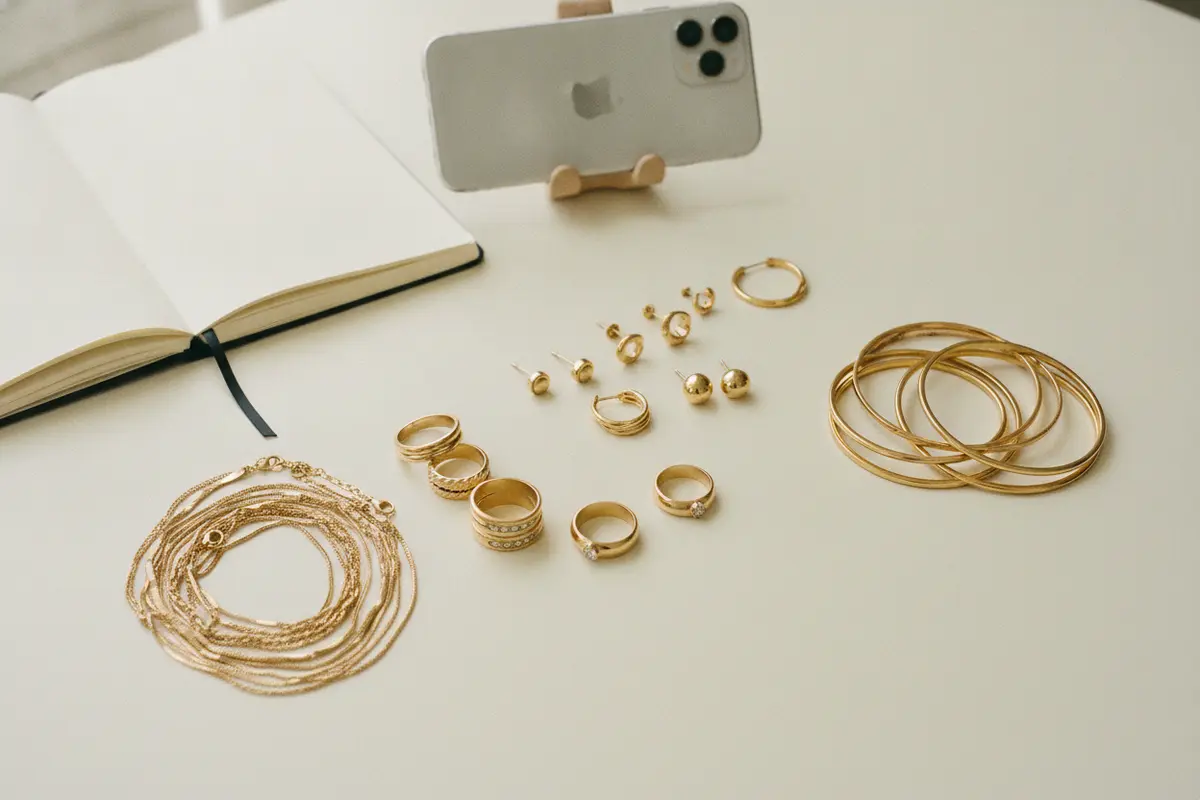
Work in small batches. For example, document the rings first, place them back in a labeled container, and then move to chains. Avoid laying every item out at once if that makes it harder to keep track. If another person is helping, agree on one naming system and have one person enter the details while the other handles the pieces.
How should you photograph each item?
Take one photograph that shows the complete piece and, when practical, a second close view of a visible stamp or distinctive feature. Use a plain background and steady light. Place one item in each frame where possible, and include the item number in the written record or filename rather than adding text over the picture.
Photographs help you recognize an item and remember its condition; they do not verify its material or value. A phone camera may not resolve a tiny stamp clearly. If a close-up is blurred, record that the mark could not be read rather than treating the image as proof. Do not bend a chain or force a clasp open just to get a better picture.
Keep the originals in a secure place and consider a backup if the images matter to your records. Avoid including personal documents or other sensitive information in the frame. If you share photos when asking a question, send only the images needed to identify the jewelry.
What is useful to record about stamps and paperwork?
Copy markings exactly, preserving the order of letters and numbers. If you can only make out part of a stamp, use a question mark or write “partly readable.” Do not fill in missing characters based on what similar jewelry often carries. A stamp is one observation, not a complete assessment of an individual piece.
Make a short document list for each item: receipt, prior appraisal, warranty or service paperwork, family note, or none available. You do not need to attach every paper to the inventory. Record where it is stored so you can find it later. Keep original documents safe; if you choose to bring information for discussion, a copy or clear photograph may be sufficient for context.
A past appraisal or purchase receipt may help explain a piece’s history, but it does not automatically establish what a buyer will offer today. Note the document date and purpose when known. For instance, a receipt records a past transaction, while an appraisal may have been prepared for a particular purpose and at a particular time. Keep those records in their proper context instead of combining them into a single assumed value.
How can you keep estimates separate from facts?
It is natural to want a total before deciding what to do. Still, an inventory is most useful when it distinguishes what you can see from what needs assessment. Avoid treating retail price, remembered purchase cost, a metal stamp, or a spot-price headline as the value of a specific finished piece. Jewelry can include different materials and construction, and its details and condition matter.
If you keep a private estimate for planning, label it clearly as an estimate and note the date and method. Do not present it as a confirmed amount or guaranteed offer. Avoid combining uncertain items into a single total; that can make it difficult to see which assumptions shaped the number. Instead, retain separate entries and questions for each piece.
Research on inventory management in the gold jewelry trade addresses how businesses organize and manage stock; that is a different purpose from a personal record, but it illustrates why clear item-level records matter. See the study on inventory management policies for gold jewelry for that business context. Your own list remains a practical aid, not a substitute for examining the item.
What fields make a useful comparison table?
A consistent template helps you spot missing information without pretending to know what an item is worth. Use one row per piece and keep questions visible until you have an answer.
| Inventory field | What to record | Example or reminder |
|---|---|---|
| Item ID | A unique label | G01; use the same ID in photo notes |
| Type and description | Form and visible design details | Chain necklace with spring-ring clasp |
| Markings | Exact visible characters | Copy the stamp; write “unclear” if unreadable |
| Condition | Visible wear or damage | Loose clasp; do not attempt a repair |
| Pair or set | Related pieces kept together | Two earrings recorded as a pair |
| Documents | Records available | Receipt, prior appraisal, or none |
| Open question | What needs clarification | Ask how the item will be assessed |
How should you organize a mixed group of jewelry?
Imagine you have a chain, two single earrings, a ring with a missing stone, and a pendant that may belong with the chain. Do not assume the pendant and chain were originally sold together. Give each a separate ID, then add a note such as “possibly related” to both entries. Photograph them separately and together only as an additional reference.
For the earrings, record each one on its own if they differ in condition or markings, then note whether you believe they form a pair. For the ring, document the missing stone and avoid trying to replace it before an evaluation. The inventory now gives you a clear account of what is present, what is damaged, and what is uncertain without turning guesses into facts.
If you find another piece later, add it as the next item rather than renumbering everything. If you change an entry after learning more, add the date and preserve the earlier note if it may be useful. This small habit makes it easier to understand what changed and when.
Review the Oceanside store visit information
What should you bring to a local evaluation?
Bring the jewelry you want discussed, your inventory, and any relevant paperwork you are comfortable sharing. Keep items grouped by ID so you can refer to your notes. If you are bringing several pieces, check your list before leaving and again when you return home. A simple count can help you confirm that each item is accounted for.
Prepare a few direct questions. You might ask what information is considered, whether pieces are discussed individually, and what happens if you decide not to proceed. If some items are uncertain, ask ahead of time whether they are within the store’s evaluation scope. This is especially helpful when you are unsure whether an object is jewelry or another kind of gold item.
For background on the local process, visit the gold buying evaluation page. Kravit Jewelers is a family-owned jewelry store in Oceanside that has served the Long Island community since 1927. The store visit information can help you plan an in-person conversation.
How can you make the conversation clear and comfortable?
Decide whether you are gathering information, considering a sale, or ready to discuss particular pieces. You do not have to make a decision simply because you brought an inventory. Take time to review any explanation, ask for clarification, and compare the items being discussed with your own notes.
Ask one question at a time and refer to the ID for the piece in question. If an explanation uses a term you do not recognize, ask what it means for that item. You can also ask whether a statement is an observation, an assessment, or a proposed offer. Keeping those categories distinct helps prevent confusion when you review the conversation later.
Afterward, make a dated note of what you learned and which items were discussed. Do not rewrite the original description as though you knew the information all along. Preserve your initial observations, then add any new information separately. You can use the updated record whether you keep the jewelry, discuss a sale, or revisit the question in the future.
What mistakes can make an inventory less useful?
- Combining similar items: Separate entries make it easier to match notes, photographs, and pieces.
- Guessing at stamps: Record only what you can read and mark uncertainty openly.
- Cleaning or repairing first: Avoid unnecessary handling that could hide a mark or worsen a delicate condition.
- Using one total for everything: Separate items and questions so uncertain assumptions do not spread across the group.
- Leaving photos unlabeled: Connect every image to its item ID in a note or filename.
- Forgetting the purpose of documents: Keep dates and context with an appraisal or receipt rather than treating all paperwork as equivalent.
These are easy problems to prevent with a short review. Before you put the jewelry away, confirm that each piece has an ID, a description, and a matching photograph or a note explaining why a picture was not practical.
Start a conversation about a gold buying evaluation
Frequently asked questions
Do I need an inventory before I visit?
No. A written list is optional. It can help you keep track of pieces and remember questions, but you can also bring jewelry without a formal inventory.
Should I clean jewelry before documenting it?
There is no need to polish or deep-clean an item for an inventory. Record its condition as you find it and avoid products or methods that could damage it or obscure a mark.
Does a stamp prove the value of a piece?
No. A visible stamp is one detail to record, not a complete assessment of value or composition. The item itself needs to be evaluated, and an inventory should not be treated as an offer.
Can I include coins or gold bars?
The store’s acceptance of specific coins or bars is not confirmed. Contact Kravit Jewelers before visiting to ask whether those items are within the scope of its evaluation.
What is a sensible next step?
Choose a small group of pieces, assign each an ID, and record only the details you can verify. When you are ready, use those notes to guide a clear conversation about an in-person evaluation in Oceanside.


