



A fine jewelry buying appointment can help turn an important purchase into a clear, considered decision. Whether you are choosing an engagement piece, a milestone gift, or jewelry for yourself, a little preparation makes it easier to explain what matters and compare options at a comfortable pace.
Explore fine jewelry and plan your visit
What should you decide before a fine jewelry buying appointment?
You do not need to arrive with every detail settled. Begin by identifying the purpose of the piece and the decisions you hope the appointment will help you make. A few clear preferences give the conversation direction while leaving room to discover an option you had not considered.
- Purpose: Is the piece for an engagement, wedding, anniversary, birthday, personal milestone, or everyday wear?
- Wearer: Who will wear it, and what do you know about their usual style and routine?
- Style: Do you gravitate toward a quiet silhouette, a more detailed design, a classic look, or something distinctive?
- Timing: Is there a date by which you hope to choose or receive the piece?
- Decision: Are you ready to select a finished piece, compare possibilities, or explore a custom direction?
It can also help to make two short lists: features you would like and details you would rather avoid. For example, you may want a ring that sits close to the hand and avoid a setting that catches on clothing. Or you may be looking for a pendant that feels special without being difficult to wear with your usual wardrobe. These practical descriptions communicate more than a broad label such as “modern” or “traditional.”
Reference images can make your preferences easier to discuss, but use them as starting points rather than specifications. Save a few examples and identify what appeals to you in each: perhaps the scale, the metal color, the shape, or the way stones are arranged. Also note whether there is anything in the image you would change. A jeweler can then help you discuss how those elements might translate into a piece that suits the wearer and intended use.
How can you set a comfortable budget and timeline?
Before the appointment, decide on a spending range that feels comfortable. You can share the range or simply explain that you would like to see choices within it. A useful budget conversation helps narrow options while making clear which qualities matter most to you. Consider in advance what you might prioritize if a piece falls outside your initial range: the material, design details, stone characteristics, overall scale, or another feature.
Ask what distinguishes the options in front of you and how those differences relate to their prices. Cost depends on the specific piece and its attributes, so a general figure for one item may not apply to another. If you are comparing two rings, for instance, ask which design or material details account for the difference and what would change if you adjusted one preference. The goal is to understand the choices, not to treat a lower price as automatically better or a higher price as proof that a piece is right for you.
Timeline matters too, especially when a date is important or you are considering a custom design. Explain the occasion and the date you have in mind, then ask what steps and decisions would be involved for the options being discussed. Do not assume that an estimate, availability, or delivery date applies until it has been confirmed for your specific selection. If the timing is flexible, say so; it may allow a broader conversation about the design or alternatives.
A simple example: someone shopping for an anniversary pendant may care most about a meaningful design and comfortable daily wear. Another shopper choosing an engagement ring may want to focus on the center stone, setting, and how the ring will sit beside a band. Both can use a budget range, but their priorities—and the questions that make the budget useful—will differ. State your most important one or two considerations first, then explore the trade-offs with the jeweler.
What should you bring to the appointment?
Bring information that helps the jeweler understand the wearer, the occasion, and the decision ahead. A phone note or a small folder is enough; you do not need an elaborate presentation. If the new piece should coordinate with jewelry you own, a clear photo may help. Ask ahead whether it would be useful to bring the actual piece, particularly when fit, proportion, or compatibility is part of the question.
- A short list of priorities, questions, and features you want to avoid.
- A few reference images, with a note about what you like in each one.
- Your preferred budget range and any decision date or event date.
- Known sizing or measurements, while recognizing that they may need to be confirmed.
- A photo or example of a piece the new jewelry should complement.
- Information about how frequently and in what settings the jewelry may be worn.
For a surprise gift, discreetly observe the recipient’s typical jewelry choices. Do they usually wear warm or cool metal tones? Are their pieces delicate, bold, or somewhere between? Do they favor necklaces, earrings, rings, or bracelets? A photo of jewelry they already wear can be more useful than a guess about exact sizing. If sizing is important, ask how to handle it rather than relying on an uncertain estimate.
If another person will help decide, think about what should be chosen together and what should remain a surprise. A partner may have strong views about comfort and daily use, while a gift buyer may be focusing on the occasion. Agreeing on a few shared priorities before the appointment can keep the conversation productive without requiring everyone to have identical tastes.
If you are considering a personal design, browse custom jewelry possibilities and the custom ring builder as ways to organize early ideas. Bring screenshots or notes about the details you like. A reference is useful for communicating inspiration, but it does not settle every final design choice, cost, or timeline.
What should you compare when viewing jewelry in person?
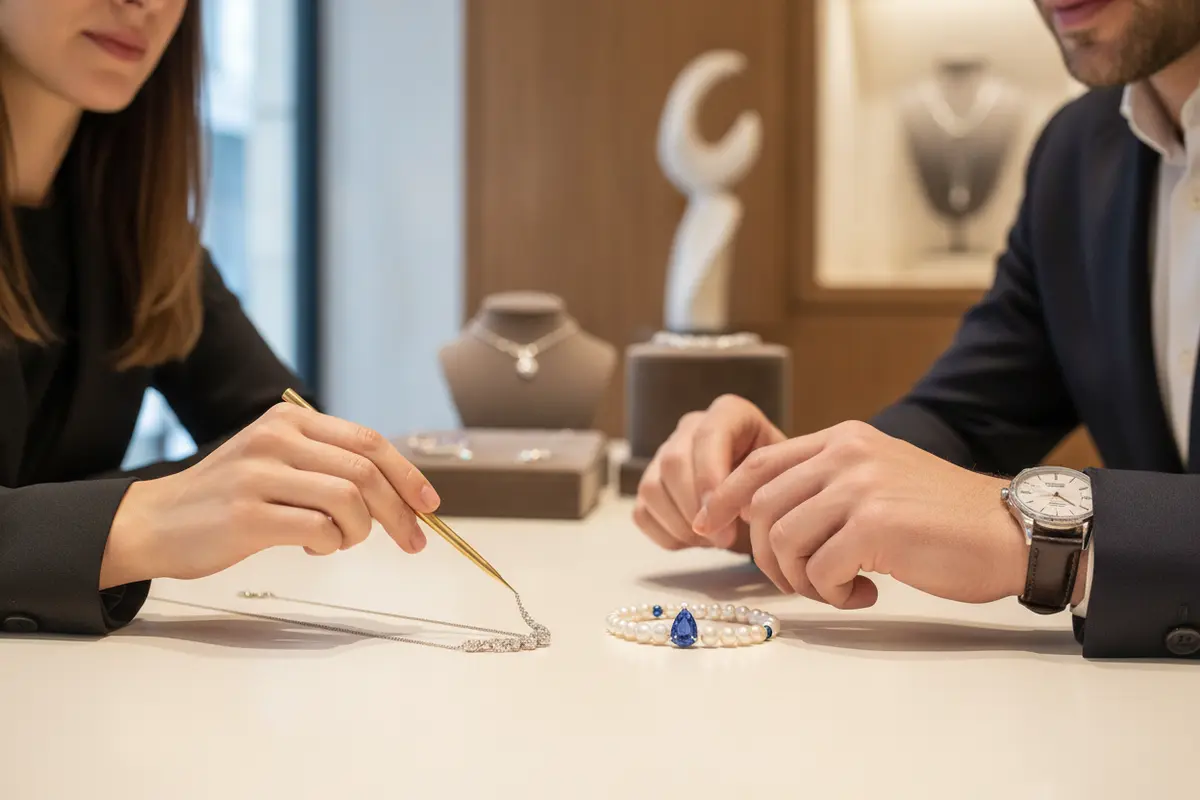
In-person viewing gives you a chance to consider more than a photograph can show. Look at the piece from different angles, notice its scale on the wearer, and pay attention to how it feels when moved or tried on, where appropriate. Compare a small number of options at a time. Seeing everything at once can make it harder to remember which details mattered.
| Comparison point | Questions to ask | What to notice |
|---|---|---|
| Proportion | Does the scale suit the wearer and intended occasion? | Balance on the hand, ear, neck, or wrist. |
| Design and material | Which details distinguish these choices? | How the finish, setting, shape, or material changes the look. |
| Comfort and movement | How does it feel when worn or handled? | Weight, profile, movement, and whether it feels natural. |
| Versatility | Will it work with the wearer’s other pieces and wardrobe? | Whether it suits the intended frequency and range of use. |
| Care and next steps | What should I understand about routine care or follow-up? | Any guidance or assessment specific to the piece. |
Think about the practical experience of each jewelry type. With a ring, notice the profile from the side, the way it feels as your hand moves, and how it may sit beside another band. With earrings, consider their weight and how they rest on the ear. With a necklace, look at chain length and how the pendant falls against clothing. With a bracelet, notice its movement and how the closure feels to use. These are individual preferences, not a universal scorecard.
For a ring purchase, compare the actual options together if possible. You might find that one looks appealing in a display but feels too prominent when worn, while another has the proportions you prefer. If the piece will be worn with an existing ring, ask to consider the pairing rather than judging the new piece alone. You can browse fine ring styles in advance, then use the appointment to discuss how a particular design fits your needs.
Educational reading can help you prepare questions about gemstones and jewelry terminology. The Gemological Institute of America offers general gem and jewelry education at GIA. Use general information as a foundation, then ask what specific details or documentation are available for the piece you are considering. The aim is to understand the item in front of you, not to assume every general explanation applies to every stone or design.
Explore custom jewelry ideas for your appointment
How can you make the conversation useful?
Describe preferences in your own words, even if you do not know a technical term. “I want something understated that feels comfortable every day” gives a helpful direction. If you are unsure whether a detail is called a particular setting or finish, ask the jeweler to explain it and show how it affects the look or feel. You can repeat the explanation in your own words to check that you have understood.
When a piece surprises you, say what caught your attention. Perhaps its color feels more suitable than the one you expected, or the scale is closer to what you had in mind. That observation can refine your preferences without requiring an immediate decision. If a partner or family member is present, invite each person to explain what matters most before comparing favorites. You may find that one person is focused on appearance while another is thinking about comfort or daily use.
It is reasonable to ask which details are known and which need further assessment. For a custom request or an item requiring additional work, clarify the steps, timing, approvals, and information needed from you. Ask what will be recorded in a written estimate or order documentation. Specifics vary by piece and project, so confirm the details rather than assuming a general explanation is a commitment.
As a family-owned jeweler serving Long Island since 1927, Kravit Jewelers welcomes shoppers who want to explore fine jewelry with personal guidance in Oceanside. You can look through fine jewelry gifts before your visit and review the Oceanside showroom information when planning your trip.
How can you compare options without rushing?
When several pieces appeal to you, use the same few questions for each one. Which best fits the purpose? Which feels comfortable? What feature would you keep, and what would you change? Does it suit your budget and timing? Comparing options against the same priorities is more reliable than trying to remember a collection of first impressions after the appointment.
You can make a simple note for each piece with four lines: what stood out, what you would change, what you still need to ask, and how it fits your priorities. For example: “Pendant A has the scale I like; ask about chain length; fits the occasion; revisit whether it works with my everyday necklace.” This brief record is more useful than a score without an explanation. If another person is shopping with you, each of you can write down a reaction before discussing it, which can reveal where your priorities align or differ.
Take a moment between options. Ask to see a piece again or request clarification about one feature rather than forcing a quick ranking. You might compare two choices side by side, then pause to consider whether the differences matter in the way you expect to wear the jewelry. If one option is clearly comfortable and practical but another has a design detail you love, ask whether there are alternatives that bring those preferences closer together.
A useful comparison should lead to better questions, not pressure to complete a formal evaluation. Keep your notes short and specific. “Looks balanced on the hand” or “feels heavier than expected” records a real observation. “Best” does not explain why a piece suits you. Linking your impression to an intended use helps you return to the decision with a clearer perspective.
What if you are not ready to decide?
A productive appointment can clarify what to consider even if you leave without making a purchase. Before wrapping up, ask which options most closely match your priorities, what information you may want to revisit, and whether anything needs assessment before you can decide. Make a quick note of the pieces you viewed and the reasons behind your preferences while the details are fresh.
There is no need to force a decision simply because you set aside time for a visit. A thoughtful purchase should make sense for the wearer, occasion, and your comfort with the choice. If you want to return with another decision-maker or compare a different style, say so directly. If timing matters, ask what can be confirmed now and what depends on a later choice, assessment, or design step.
Before you leave, summarize your understanding: the option or direction you prefer, the questions still open, and any next action you have agreed on. This simple recap helps prevent assumptions from taking the place of clear expectations. If you decide to continue, keep the budget, design notes, and timing questions together so the next conversation can pick up where this one ended.
Explore fine jewelry and plan your visit
Frequently asked questions
How long should I allow for a fine jewelry appointment?
Allow enough time to explain what you are looking for, compare relevant options, and ask your questions. If you have a firm schedule, mention it when arranging the visit so the conversation can be focused on your priorities.
Should I bring a partner or family member?
Bring someone if they will help decide or wear the piece. If the purchase is a surprise, notes and photos that reflect the recipient’s usual style may be more useful than bringing another decision-maker.
Can I come in without knowing exactly what I want?
Yes. Start with the occasion, a general style preference, and how you hope the piece will feel or be worn. You can use the conversation to narrow your preferences and identify questions for further comparison.
What should I ask about a custom jewelry design?
Ask how ideas will be reviewed, which choices require your approval, what stages and timing are expected, and how the cost depends on the final design. Confirm details for your project before moving forward.
What is a sensible next step?
Write down your priorities, gather a few useful references, and choose the questions that will help you compare pieces. When you are ready, plan a visit to Kravit Jewelers in Oceanside and bring your ideas to the appointment.


