




Learning how to wind a mechanical watch starts with identifying its movement and handling the crown gently. Whether you have inherited a timepiece or are considering your first mechanical watch, a calm routine helps you operate it without forcing a part that feels resistant. The model's instructions always take priority over general advice.
Explore watches at Kravit Jewelers
What should you identify before winding a mechanical watch?
A mechanical watch stores energy in a mainspring. In a hand-wound movement, turning the crown tightens the spring. In an automatic movement, a weighted rotor responds to ordinary wrist motion and helps wind the spring. Many automatic models also allow hand winding, but this depends on the design.
Start with the instruction booklet, model reference, or maker's documentation. Look for the movement type, crown positions, winding direction, and any directions for starting a stopped watch. If you do not know the model, avoid guessing at a winding count. A watch that has stopped may simply have run down, but it may also have a different issue.
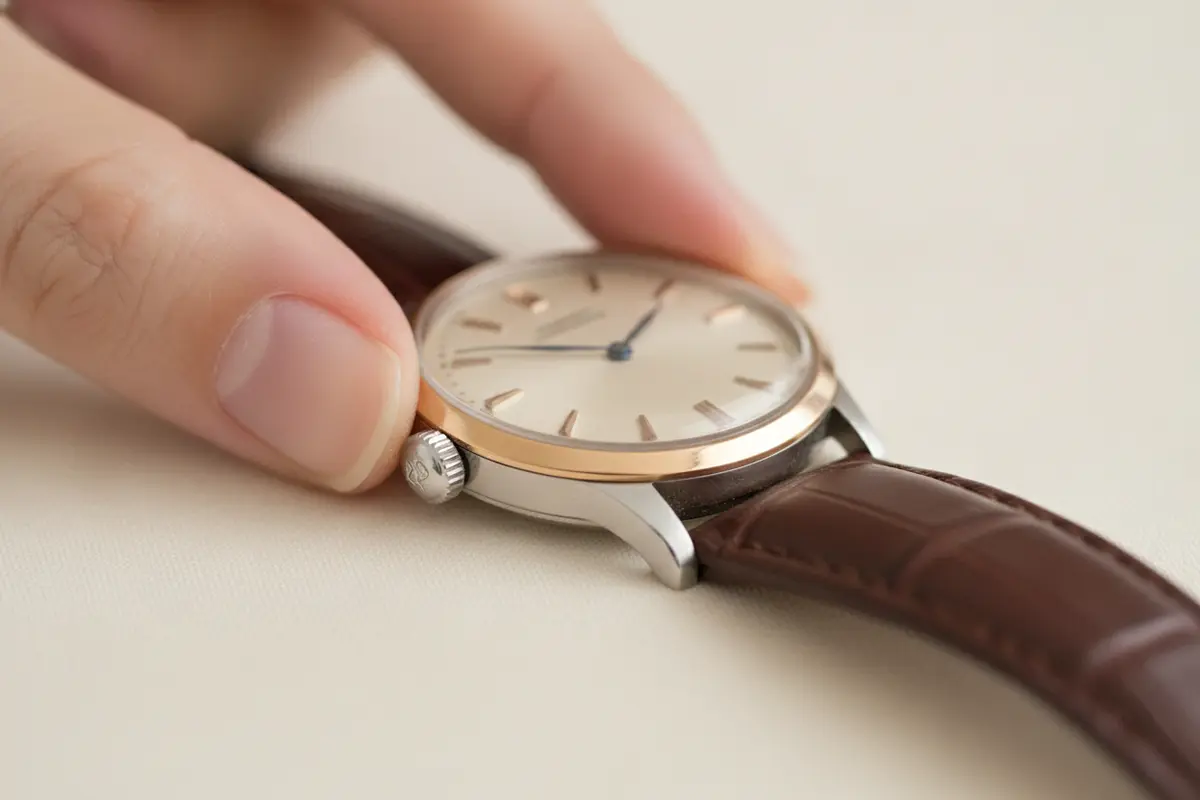
Identify the crown before touching it. This small knob, usually at the side of the case, may push in, pull out to one or more setting positions, or screw down. A screw-down crown must be released before normal winding and secured afterward, but the exact method varies. Do not pull against a locked crown or turn one that feels stuck.
Also consider the watch's condition. If the case or crown is wet, dry the exterior and do not operate the crown until you have checked the manufacturer's water-resistance guidance. Water resistance can change with age or damage, and the crown is an opening through which moisture may enter if not secured correctly.
How do you wind a hand-wound mechanical watch?
- Take it off your wrist. Hold the case in one hand and the crown between the fingertips of the other. This steady position helps prevent sideways pressure on the crown and stem.
- Release a screw-down crown if instructed. Follow the maker's directions and rotate gently until the crown releases. Do not pull it outward while it is still screwed down.
- Leave the crown in its winding position. For many designs this is the fully pushed-in position, but not all models are identical. Check the manual rather than relying on a familiar watch's layout.
- Use small, even turns. Turn the crown smoothly with the pads of your fingers. Do not jerk it, use a tool, or grip it with pliers. The appropriate direction is model-specific; the instructions are the reliable reference.
- Pay attention to changing resistance. Some hand-wound watches grow firmer as the spring approaches its limit. Stop when it feels firm or you notice catching, grinding, or an unfamiliar sensation. Do not try to prove that the watch is fully wound.
- Return and secure the crown. Push it back only as directed. If it screws down, start gently so the threads engage cleanly; stop if it catches, and do not overtighten.
For a watch that has stopped, wind only as far as the manual recommends. If it begins running, set the time using the maker's instructions and observe whether it continues. A daily winding routine may suit some hand-wound watches, but the correct frequency depends on the movement and its power reserve. Avoid adopting another owner's schedule without checking your own model.
A simple example: if a watch ran normally yesterday and has stopped after sitting unused, consult the instructions and try the permitted winding procedure once, gently. If it starts, you can follow its normal routine. If the crown stops abruptly, feels rough, or the watch remains still, repeated turns are not a useful test. Stop and arrange an assessment instead.
How should you wind an automatic mechanical watch?
An automatic watch is intended to receive energy from the movement of its rotor while worn. If it has been left aside long enough for its reserve to run down, the manufacturer may permit hand winding to start it. Confirm the recommended method, crown position, and number of turns in the model's manual before proceeding.
When hand winding is permitted, keep the motion smooth and light. Do not shake the watch hard or swing it to make the rotor move. Vigorous movement does not replace proper operation and may put unnecessary stress on the case or bracelet. Once running, wear the watch as intended and see whether ordinary use keeps it operating as expected.
Some automatic watches have a slipping mechanism that helps prevent the spring from being wound past its limit during normal use. That feature is not permission to force the crown. Hand-winding designs differ, and resistance, scraping, or a sudden change in feel should be treated as a reason to stop, not as a challenge.
What is the difference between manual and automatic winding?
| Question | Hand-wound movement | Automatic movement |
|---|---|---|
| Where does energy come from? | The wearer turns the crown to wind the mainspring. | Motion of an internal rotor winds the mainspring during wear; hand winding may also be supported. |
| What should the owner check? | Instructions for winding direction, frequency, and the point at which to stop. | Instructions for starting a stopped watch and whether hand winding is allowed. |
| What if it has stopped? | Try only the documented winding process, gently, and observe whether it runs. | Use the model's approved start-up method; do not shake it vigorously. |
| When should you stop? | If the crown grows unusually firm, catches, grinds, or the watch does not respond. | If winding feels abnormal, the crown binds, or it repeatedly stops unexpectedly. |
These are general distinctions, not a replacement for model-specific instructions. The University of South Florida's description of a self-winding watch explains that internal rotating parts wind the mechanism through motion.
Which winding mistakes should you avoid?
- Do not force the crown. Resistance, grinding, a slipping sensation, or sudden stiffness can indicate a problem. Stop rather than applying more pressure.
- Do not turn a crown in the setting position by assumption. Crown positions and functions vary. If the manual does not explain the position, pause instead of experimenting.
- Do not wind a wet watch. Keep moisture away from the crown and follow the manufacturer's water-resistance instructions.
- Do not use tools. Pliers, gripping devices, or improvised levers can damage the crown, stem, case, and finish.
- Do not use shaking as a shortcut. This is not a substitute for the recommended procedure on an automatic watch.
- Do not repeat a failed attempt indefinitely. If a careful, permitted attempt does not work, further winding may add risk without explaining the cause.
- Do not open the case to investigate. The movement is delicate, and opening a case can expose it to dust or moisture. Leave internal inspection to a qualified professional.
What can the feel of the crown tell you?
A smooth and consistent feel is easier to handle than a crown that catches, slips, grinds, or wobbles. Feel alone cannot diagnose a movement, and some designs naturally have different tactile feedback. Still, a new or pronounced change is useful information. Stop if the crown is unusually stiff, spins without its usual response, will not return to its normal position, or seems loose.
Look for other signs that call for caution. Moisture or fog beneath the crystal, a crown that no longer sits correctly, damage after a drop, or repeated stopping are reasons to avoid further experimentation. If the watch is important or has sentimental value, a conservative approach protects it better than trying multiple winding techniques.
When discussing the concern with a watch professional, describe what you observed rather than offering a diagnosis. For example, say that the crown turns smoothly for a few rotations and then catches, or that the watch ran briefly and stopped. This concrete account is more useful than saying only that it needs winding.
How can you tell a simple run-down from a possible problem?
A watch that stopped after being unworn may simply have exhausted its stored energy. If the manual gives a starting procedure, follow it and note whether the watch resumes operation. A single successful restart followed by normal running is different from a watch that repeatedly stops after a short time or cannot be started by the stated method.
Consider these example situations:
- The watch was set aside, and the crown works normally. Check the model instructions, wind or start it as directed, then set the time carefully. Observe its operation without repeatedly adjusting the crown.
- The crown will not turn or becomes firm almost immediately. Stop. Do not use extra pressure or assume the spring is fully wound; a professional can determine whether there is a mechanical issue.
- The crown turns freely but the watch does not respond. Note the behavior and avoid continuing to wind. A loose-feeling crown may warrant inspection.
- The watch starts but stops again unexpectedly. Record when this happens and whether it was worn or left stationary. Repeated stopping deserves assessment rather than a larger winding count.
- The watch was dropped or exposed to water. Do not continue operating it. Keep it dry and seek advice, especially if you notice condensation or impact damage.
These examples are not diagnoses. They are a way to decide when to stop at-home handling and what facts to share during an evaluation.
How can you prepare for a watch assessment?
Before visiting a jeweler, write down the make and model if known, whether the movement is manual or automatic, and when it last ran normally. Bring the instruction booklet, warranty information, or service records if available. Note any drop, water exposure, unusual sound, crown resistance, or steps you already tried.
Keep the description specific and brief. “It stopped after two days unworn” gives a different starting point from “it stopped after I turned the crown and felt resistance.” Include whether the watch restarted and for how long. Do not keep repeating a test just to collect more information; report what happened during the first careful attempt.
Kravit Jewelers serves customers in Oceanside and across Long Island, with watch expertise as part of its broader fine jewelry and watch offering. A local conversation can help you explain what you noticed and ask what evaluation may be appropriate. You can also explore the watch collection or browse more watch and jewelry guides as you consider your next step.
Explore the pre-owned watch selection
How can you make a winding routine easier to follow?
A repeatable routine reduces uncertainty. Keep the instruction booklet somewhere accessible, use a clean and dry work surface, and remove the watch from your wrist before winding. Choose a well-lit spot so you can see whether a screw-down crown is fully released or whether the crown is pulled into a setting position.
For a hand-wound watch, follow the documented schedule and stop at the stated limit or at unusual resistance. For an automatic watch, use ordinary wear as intended and consult the manual if it runs down after being set aside. Avoid changing your approach from day to day. A consistent method makes it easier to notice a meaningful change in the crown's feel or the watch's behavior.
If you own more than one mechanical watch, do not assume they share the same instructions. One may have a screw-down crown, another may not; winding directions and permitted procedures can differ. Keep each watch's model information paired with the watch, rather than relying on memory or applying the routine of a different movement.
What details should you compare when reading watch instructions?
When documentation is available, focus on the practical details that affect safe handling. Find the illustration showing crown positions, confirm whether the watch is hand-wound or automatic, and identify any separate procedure for a stopped watch. Read the section on securing a screw-down crown and any cautions about water resistance. If instructions conflict with a general tip in an article, follow the maker's model-specific directions.
Take care with advice that gives a universal number of turns or guarantees a particular result. Power reserve, crown design, and movement construction differ. A specific count may be right for one model and wrong for another. The useful question is not “How many turns do all watches need?” but “What does this watch's maker recommend, and what should I do if its response feels abnormal?”
If you have no documentation, identify the maker and model before winding further. A reference number may appear on paperwork or the case, but do not remove the caseback to find it. If you cannot identify the movement confidently, ask a professional rather than testing several crown positions.
Frequently asked questions
How many turns should I give a mechanical watch?
There is no single number for every watch. Follow the maker's instructions, use gentle turns, and stop if the crown becomes unusually firm or resists.
Can I wind a mechanical watch while wearing it?
Removing it is usually easier because you can hold the case steadily and turn the crown without pushing at an angle. Follow the model's directions if they specify another method.
Can an automatic watch be wound by hand?
Many automatic watches permit hand winding, but not every model should be handled the same way. Check its documentation for the correct procedure before turning the crown.
What if my watch stops again after I wind it?
Note when it stops and whether it was worn, then stop repeated winding experiments. If it does not run as expected after the documented procedure, arrange a professional assessment.
Should I shake an automatic watch that has stopped?
No. Do not shake it vigorously. Check the manufacturer's instructions for a permitted start-up method, and use only that procedure.
Explore watches and request guidance
What is a sensible next step?
Use the watch's instructions, handle the crown gently, and stop as soon as you feel unusual resistance. If the watch does not respond as expected, a professional assessment is safer than forcing the mechanism.


