



Explore vintage jewelry with a careful look at its condition, marks, and paperwork before you buy. A striking silhouette may catch your eye first. The setting, wear, workmanship, and seller's description also shape what you are taking home. Thoughtful questions help separate visible facts from claims that need documentation or professional review.
Discuss your vintage jewelry questions with Kravit Jewelers
Before buying vintage jewelry, inspect stone security and visible wear, review maker or metal marks as clues rather than proof. Ask about repairs and replaced parts, and request a written description with available records. If value matters, clarify the purpose and limits of any appraisal; it does not guarantee authenticity or future resale value.
Use this guide to evaluate the piece in front of you, identify the questions that remain, and decide when a jeweler's assessment or purpose-specific appraisal may help.
What should you inspect first when buying vintage jewelry?
| Check | What to look for | Question to ask |
|---|---|---|
| Stones and settings | Movement, chips, abrasions, or missing stones | Has any stone or setting been repaired? |
| Metal and finish | Dents, deep scratches, worn areas, or changed finish | What wear is known, and what work may be needed? |
| Closures and hinges | Loose parts, stiffness, gaps, or incomplete components | Have any components been replaced or adjusted? |
Start with stone security, visible wear, and moving parts; these checks can reveal condition issues that deserve closer review before you buy.
Look closely at each gemstone and its setting. A stone that shifts in its mounting may not be secure and could fall out, so do not treat movement as a minor cosmetic flaw. With the seller's permission, view the piece through a jeweler's loupe and check for chips or abraded facets. GIA recommends these checks when evaluating jewelry. (GIA's jewelry-buying guidance.)
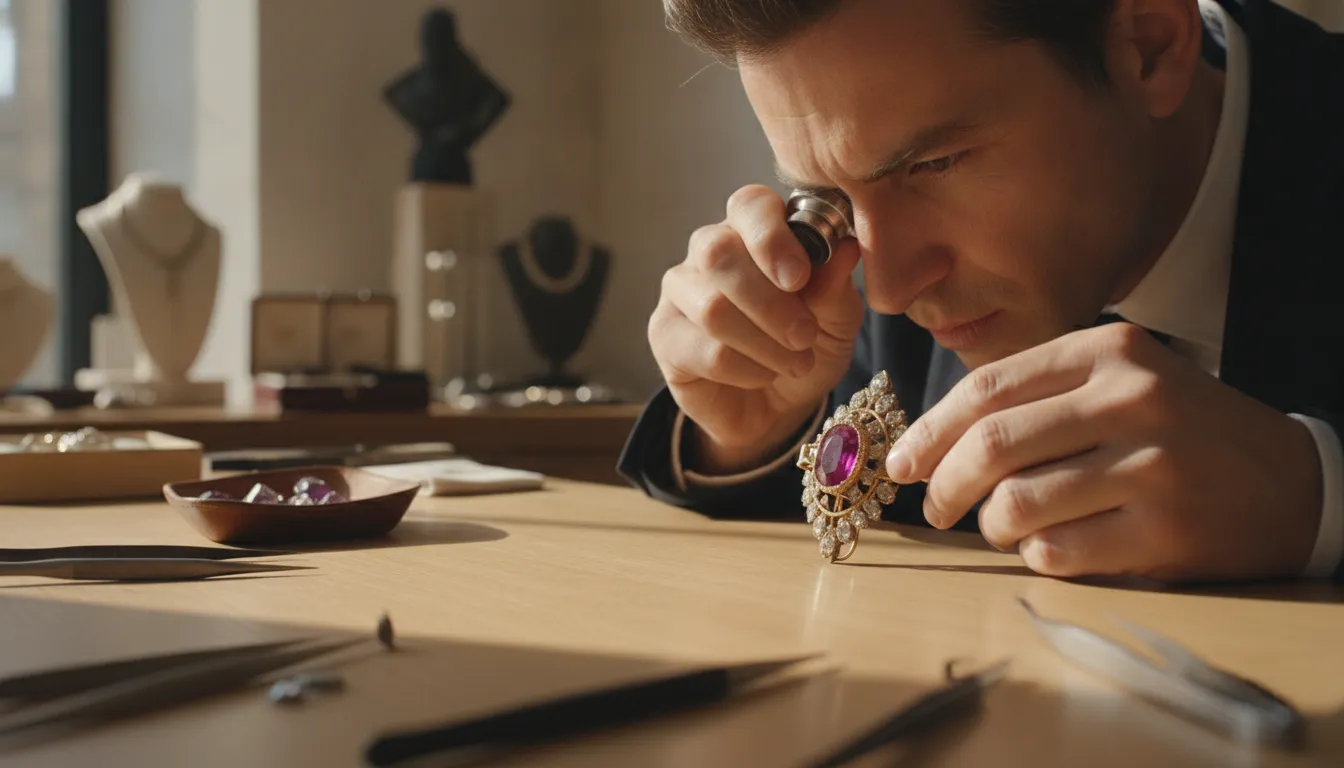
Next, examine the metal under good light. Small surface marks may be consistent with prior wear, while dents, deep scratches, or missing stones merit specific questions about the piece's history and any needed work. Inspect the finish, too: polished, textured, and matte surfaces can all show damage. These observations help you describe what you see, but they do not establish the jewelry's age or full history.
Patina is not automatically a defect. A softened surface or gentle change in appearance may be part of how a piece has aged. A crack, sharp dent, worn-through area, or damaged setting can affect its stability or use. Ask the seller to distinguish expected wear from damage, and request that any concern be noted in writing. For a vintage-inspired look, see Kravit's guide to stackable wedding rings.
Check clasps, hinges, pins, and closures by gently operating them if the seller permits. They should move as intended and stay closed; avoid forcing a stiff or delicate mechanism. Look for absent stones, dangling components, uneven gaps, or signs that a clasp or hinge has been altered. Ask whether missing or replaced parts are known, and whether the seller has noticed intermittent problems. A visual inspection is not a guarantee that a piece is sound, so ask for a qualified jeweler's closer assessment when anything feels loose or uncertain.
Keep the findings separate from the story attached to the piece. Condition describes what is visible now; it cannot by itself confirm authenticity, age, or provenance. Record questions before committing, and review the seller's written terms alongside any description of materials, repairs, or alterations.
How can craftsmanship reveal how a vintage piece was made?
Settings, joins, and signs of repair can help explain construction and wear, but they cannot confirm a piece's age or history alone.
Examine the setting, joins, and wear together, then compare your observations with the seller's description and any supporting records.Start with the way the parts meet. Look for settings that hold stones evenly, prongs or bezels that appear secure, and joins that seem consistent with the surrounding metalwork. Differences in finish or alignment may be worth asking about, but they are not automatic defects: a piece may have been repaired, adjusted, or made by hand. GIA recommends looking for repair evidence in estate jewelry, including solder joints that appear unlikely or out of place. Such details can prompt questions about the work performed; they do not, by themselves, date a piece or prove its history (GIA's estate jewelry buying guide).
Inspect beyond the most visible surface. If practical, look at the back of a setting, the inside of a ring, the clasp of a bracelet, or the hinge of a locket. These areas may show wear, older repairs, or construction differences that are harder to notice from the front. Tool marks or irregularities can be observations to discuss with a knowledgeable jeweler, not a shortcut to authentication. Likewise, a polished exterior may obscure earlier wear, while visible wear can reflect use rather than a specific age.
Consider whether the construction suits the way you intend to wear the piece. A delicate setting or fine chain may need more careful handling than a sturdier design. Ask whether stones feel secure and whether a clasp, hinge, or closure functions properly. If you notice a mismatch between the piece's condition and the seller's account, request a clear explanation of repairs or alterations before buying.
Finally, separate period style from evidence. Geometric lines, engraved details, or filigree may evoke a design era, but attractive styling alone does not verify when or where a piece was made. For an example of Art Deco design vocabulary, see this Art Deco platinum wedding ring. Use it as a style reference, not as proof that a similar-looking piece shares its age or origin. Construction clues are most useful as part of a broader review that includes condition, marks, documentation, and the seller's written description.
What can hallmarks tell you about vintage jewelry?
A hallmark may identify a maker or indicate metal type and fineness. It is only one clue, not proof of a piece's full history.
A hallmark or stamp is a useful clue, not a complete verdict on a piece.
A maker's mark can help identify the workshop or company associated with a piece, while a metal-quality stamp may indicate the metal type and fineness. GIA recommends looking for a maker's mark and explains that quality stamps indicate the type and fineness of the metal (F004, F005). Such marks are often placed discreetly; for example, a ring's stamp may be inside its shank (F007). Use good light and, if available, a jeweler's loupe to inspect small or shallow marks without scratching the piece.
The word hallmark can refer to different marking systems, so its meaning depends on where and when the jewelry was marked. GIA notes that European hallmarks can indicate metal type, fineness, and country of manufacture (F006). The Sheffield Assay Office describes UK marks in terms that can include a sponsor's mark, fineness, and assay office. In that UK context, a date letter can offer a dating clue, but it is voluntary; this should not be assumed to apply to jewelry from other jurisdictions. See the Sheffield Assay Office guide to UK hallmarks for that specific system. A mark that seems unfamiliar is not necessarily suspicious, but it merits careful interpretation.
Marks can be worn, partly hidden, incomplete, or difficult to read. A stamp may also reflect only one component: a repaired or altered piece could contain replacement parts, and a metal mark does not identify a gemstone. A clear, plausible mark therefore cannot certify the item's full composition, maker attribution, history, age, or the identity of its stones. Likewise, a missing or illegible mark alone does not establish that the piece is misrepresented. Ask what each mark is being used to support, and whether other evidence backs up the description.
When comparing the seller's description with the marks, look for specific, consistent statements about the metal and any claimed origin or treatment. The FTC's Jewelry Guides address truthful representation of jewelry characteristics, including metal content, quality, treatment, and origin. They do not make a particular stamp a guarantee. If age or maker attribution matters, ask for the basis of that claim and any written records. A receipt can preserve the seller's description of materials and approximate age. It is documentation, not independent proof of every detail (F014).
What provenance questions should you ask before buying?
Ask for written details about materials, estimated age, alterations, supporting records, and the seller's terms before you commit.
Start with what the seller can document, rather than what the piece is said to have belonged to. GIA recommends requesting a receipt with a written description that includes the materials and approximate age. That record gives you a clearer basis for comparing the seller's description with the jewelry itself, though it does not independently establish the item's complete history.
- What exactly is included in the sale? Request a written description identifying the piece, stated metal and gemstone materials, and any components that are not original, if known. If a stone has a grading or identification report, ask to review the actual report and confirm which stone or item it describes.
- How was the approximate age determined? Ask whether the estimate comes from dated paperwork, a prior owner, a maker's mark, or the seller's assessment of the design and construction. Ask what evidence supports a named period or date. Style can inform an estimate, but a confident label alone is not a documented history.
- Has the piece been repaired, altered, or resized? Ask what work was done, when it was done if known, and whether records are available. Find out whether stones, clasps, settings, or other components have been replaced, and whether any original parts accompany the item. Previous work is not automatically a reason to reject a piece, but it can affect what you are buying and what future care may involve.
- Are there earlier appraisals, laboratory reports, receipts, or ownership records? Ask to see copies and check that each document relates to this specific item. A prior appraisal records an appraiser's description and opinion of value for a purpose; it should not be treated as proof of every historical claim.
- What are the return and warranty terms? Ask for the policy in writing before paying. Clarify the return window, any conditions on returns, and what the warranty covers or excludes. GIA also advises buyers to read and understand return-policy or warranty information.
Keep the seller's answers and documents with the receipt. Without paperwork, claims about prior ownership, exact age, or original components remain unverified. Kravit's Art Deco jewelry guide can help you notice style details. It is not a provenance record.
For a practical checklist, see GIA's estate jewelry buying advice. Descriptions and papers can support careful review, but they do not guarantee authentication or ownership history.
When is an appraisal useful for vintage jewelry?
An appraisal describes a piece and estimates value for a defined purpose. It does not guarantee age, authenticity, or future resale value.
Use one when you need a written description and value estimate for a specific purpose, such as evaluating a purchase, planning an estate, or arranging insurance. Clarify what the appraiser is valuing and what the document does not establish.
Appraisals are not interchangeable. GIA says the stated value is an appraiser's opinion based on research and experience. The intended use matters. Insurance may call for replacement value, while estate planning may need fair market value. A pre-purchase appraisal should address the buying decision, not predict a future sale. Ask for the purpose and value basis in writing.
Also distinguish an appraisal from a gemological report. A grading report describes a gemstone's characteristics; an appraisal estimates monetary value. A report may document a stone, but it does not value the full piece, its setting, or condition. Neither document guarantees age, provenance, authenticity, or a future sale price. GIA explains these distinctions in its jewelry appraisal guidance and its overview of grading reports and appraisals.
Before commissioning an appraisal, ask about the appraiser's education and experience. GIA recommends relevant gemological and appraisal training. It also advises asking whether the appraiser works independently or for the seller. Knowing that relationship helps clarify the context for the opinion, but does not replace qualifications.
Review the description for materials, stones, condition, and visible repairs. Check any assumptions about age or identification. Ask what could not be confirmed and whether the appraiser relied on seller-supplied records. Compare the report with the piece and request clarification if needed. GIA also recommends recording materials and approximate age, especially for insurance appraisals.
For a closer look at what an appraisal can and cannot tell you, read Kravit Jewelers' guide to jewelry appraisals. Treat the document as a purpose-specific professional opinion, not a promise of resale value or proof that every historical detail is certain.
How can a Long Island jeweler help you assess a piece?
A jeweler can assess visible condition and discuss next steps. They can separate observations from claims that need records or specialized review.
An experienced jeweler can help you examine a vintage piece, explain what a visual review can and cannot establish, and discuss questions to resolve before you buy. Kravit Jewelers has served Long Island since 1927, with jewelry repair, restoration, and appraisal services in Oceanside.
During an in-person review, a jeweler may inspect the setting, visible wear, clasps, hinges, and signs of earlier repairs. A loupe can reveal chips or abraded facets that are easy to miss at a glance. GIA recommends checking gemstones for damage and looking for repair evidence in estate jewelry (GIA's estate jewelry inspection guidance).
That assessment has limits. A hallmark, construction detail, or apparent wear does not establish a piece's complete history or guarantee its age, maker, or authenticity. Ask the jeweler to separate visible observations from matters requiring records or specialized examination. If the seller has records, compare them with the piece and ask about replaced stones, altered components, or prior repairs.
Repair or restoration may be worth discussing if the piece has loose settings, damaged components, or signs of earlier work. Before authorizing any alteration, ask what the proposed work would involve, whether it could affect original details, and what uncertainties remain. The appropriate approach and estimate depend on the individual piece and its condition. A consultation should not be taken as a guarantee that a particular restoration is possible or will produce a specific result.
If you need a formal appraisal, first explain its intended purpose. An appraisal describes and values property, and its stated value is the appraiser's opinion based on research and experience; different purposes can call for different value approaches. Ask what the report will identify, what documentation supports it, and whether the appraiser's qualifications suit the work. An appraisal is not, by itself, proof of a piece's provenance or authentication.
Kravit Jewelers has served Long Island since 1927 and offers repair, restoration, and appraisal services in Oceanside. Learn more about jewelry repair and restoration services when a piece raises questions about wear or previous work.
Frequently Asked Questions
How old does a piece need to be to count as vintage?
There is no single definition used by every seller. GIA describes vintage jewelry broadly as non-contemporary and not old enough to be antique; some sellers apply a specific age range. So ask how the seller is using the term and request the stated age basis in writing. GIA explains the terminology.
What should I ask before buying a piece online?
Request clear photographs of the front, back, marks, settings, and any areas of wear, along with a written description of the materials, approximate age, repairs, and replaced parts. Confirm what is included in the sale and read the return policy or warranty before paying. GIA likewise advises buyers to review return terms and obtain a written description of materials and approximate age. See GIA's estate jewelry buying guidance.
Does an appraisal prove that a piece is authentic?
No. An appraisal describes and assigns a value for a stated purpose. It is the appraiser's opinion based on research and experience, not a guarantee of authenticity or future resale value. Ask what the report does and does not evaluate, and choose an appraiser with relevant gemological and appraisal training. GIA explains appraisal scope and qualifications.
Can age alone tell me what a piece is worth?
No. A date or period attribution is only one part of the evaluation. Materials, condition, workmanship, documentation, and the purpose of a valuation all matter. And an appraisal value is an informed opinion rather than a promise of what a later buyer will pay. If value information is important to your decision, ask what kind of appraisal or assessment is appropriate before completing the purchase.
Contact us to discuss a vintage jewelry appraisal
A careful review can help you understand what an appraisal is intended to address before you make a purchase decision. To discuss a pre-purchase appraisal and professional guidance for a vintage piece, contact Kravit Jewelers about appraisal services. The appropriate scope depends on the piece and the purpose of the appraisal, so sharing your questions in advance can help guide the conversation.


