




Start with the way you want a piece to live in your wardrobe, not with a color chart. A gemstone that catches your eye may be perfect for a special gift. A daily ring or bracelet calls for closer attention to setting, lifestyle, and durability.
Explore custom gemstone jewelry design
Choosing gemstone jewelry means balancing color, personal meaning, and everyday wearability. Let your preferred hues and the symbolism you connect with guide the first choice, then consider how the stone will handle the activities and care your routine requires.
Color can express a memory, milestone, or simply a distinctive sense of style. Meaning may come from tradition, but it remains personal rather than a fixed gemological fact. As you narrow the field, the most thoughtful choice begins with what the stone represents to you and continues with how it will perform in real life.
What Makes Gemstone Jewelry Meaningful?
Gemstone jewelry becomes meaningful when its color, symbolism, and story connect with the person who wears it. The gem may reflect a milestone, honor a family tradition, or simply capture a color that feels unmistakably personal.
Explore custom gemstone jewelry design
Color is often the first point of recognition. A sapphire is usually associated with blue, but it also occurs in a range of other colors. That flexibility allows a piece to feel distinctive while retaining the established identity of the gem. Amethyst brings lilac to deep purple hues, while opal can show an expressive play of color that changes with the angle and light.
Traditional symbolism can add another layer, provided it is understood as tradition rather than a measurable property of the stone. GIA notes that sapphire has traditionally symbolized sincerity, truth, faithfulness, and nobility. Amethyst has been associated with personal empowerment and inner strength, and opal has historically represented love, hope, purity, and truth in different cultures. These associations do not determine what a gemstone means to you, but they can offer a thoughtful starting point for a gift or custom design.
Personal history may matter even more than folklore. A birthstone can mark a birthday, while a colored gem selected for an anniversary may recall a favorite place, a shared memory, or a meaningful season. For a broader month-by-month reference, explore this guide to gemstone color and meaning.
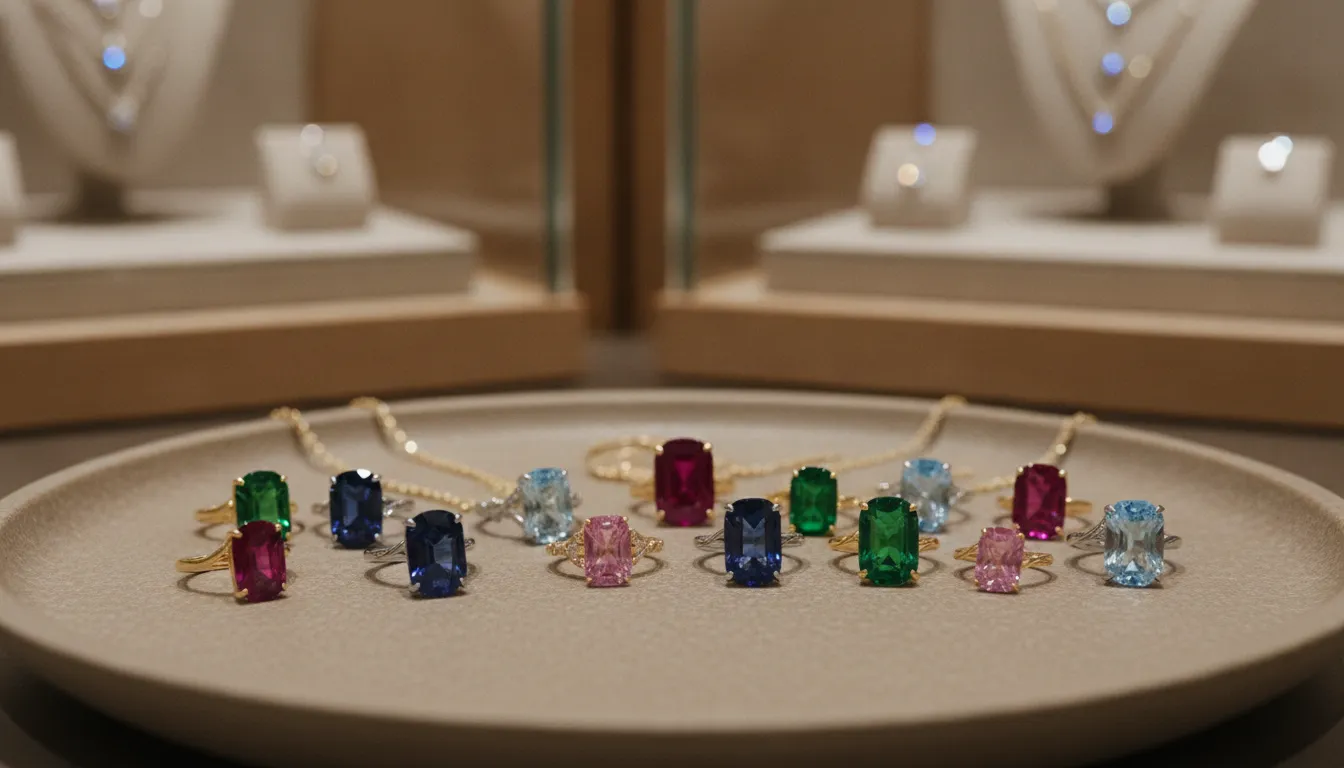
Meaning also develops through design. The same stone can feel modern in a clean solitaire, sentimental in a family-inspired setting, or quietly distinctive as an accent in earrings or a bracelet. Kravit's gemstone portfolio includes pieces featuring emerald, ruby, sapphire, aquamarine, tourmaline, topaz, and charoite. A knowledgeable jeweler can help translate your preferred color and story into a design while keeping the stone's documented characteristics in view.
How Do You Choose a Gemstone Jewelry Color?
Choose a gemstone jewelry color by balancing its hue, saturation, and tone with your wardrobe, skin contrast, lifestyle, and the personal meaning you want the piece to carry.
Start with hue, or the gemstone's basic color family. Blue sapphire can create a classic, tailored impression, while amethyst brings a distinctly purple presence. Sapphire is not limited to blue, however. GIA notes that sapphire occurs in a rainbow of colors, while ruby is the red variety of corundum. Looking beyond familiar color names can help you find a piece that feels individual without losing a sense of refinement.
How do saturation and tone change the look?
Saturation describes the strength or intensity of a color. A highly saturated stone looks vivid and expressive, while a less saturated stone may feel softer and more understated. Tone describes how light or dark the color appears. A pale blue or lilac stone can complement a delicate daytime wardrobe, whereas a deeper tone may provide stronger contrast for evening clothing or neutral tailoring.
Compare stones in the kind of light in which you expect to wear them. Then place them near the colors already in your wardrobe. Navy, denim, white, cream, charcoal, and black can make different gemstone colors appear more or less prominent. The right choice is not necessarily the brightest stone. It is the one whose color gives your clothing and complexion the balance you prefer.
Should a gemstone color have personal meaning?
Meaning can make a color feel more lasting. Sapphire has traditionally been associated with sincerity, truth, faithfulness, and nobility. Amethyst, the purple variety of quartz, ranges from lilac to deep purple and has traditionally been linked with personal empowerment and inner strength. Opal has historical associations with love, hope, purity, and truth. These are cultural traditions and symbols, not guarantees about a stone or the person wearing it.
Opal is also recognized as an October birthstone, but you do not need to be born in October to wear it. GIA explains that the belief that people born in other months should avoid opal came from a nineteenth-century novel rather than an ancient belief or experience. For a broader look at how birth months, colors, and traditions intersect, compare birthstone color and meaning.
Finally, consider how often you want to wear the piece and whether its setting will be a ring, pendant, bracelet, or earrings. A consultation can help you compare color in person while keeping the design aligned with your style and intended use.
What Does Gemstone Jewelry Need for Everyday Wear?
Everyday gemstone jewelry should be chosen for hardness, toughness, stability, setting protection, and the way you live. A beautiful color is only one part of a practical choice. GIA explains that durability includes a gem's ability to withstand wear, heat, light, household chemicals. And changes in humidity, so hardness alone cannot answer whether a stone belongs in a daily ring, pendant, or bracelet.
How should you read the Mohs scale?
The Mohs scale ranks mineral hardness from 1 to 10 and helps indicate resistance to scratches and abrasions. However, it is a relative, non-linear scale. A stone rated 8 is not simply twice as hard as one rated 4, and a high rating does not mean the gem cannot chip or fracture. GIA notes that diamond, despite being the hardest gemstone, can break after a hard blow because toughness and hardness are different properties.
Ruby and sapphire are both varieties of corundum and rank 9 on the Mohs scale. That makes them strong candidates for active lifestyles, but the individual gem, its setting, and the wearer's habits still matter. A ring exposed to tools, sports, or repeated impact may need a more protective design than earrings or a pendant worn under less demanding conditions.
| Consideration | What it tells you | Practical question |
|---|---|---|
| Hardness | How well the gem resists scratches and abrasions | Will it rub against other jewelry or hard surfaces? |
| Toughness | How well the gem resists breaking, chipping, or cleaving | Could the piece receive frequent impact? |
| Stability | How the gem responds to heat, light, chemicals, and humidity | Will it face household tasks, sun, or changing conditions? |
When is a softer stone better for special occasions?
Softer gemstones can be wonderful choices when their color and character are the priority. GIA advises that some gems with lower Mohs hardness may be better reserved for special occasions rather than everyday wear. Lifestyle also includes how a piece is worn: a softer stone in a protected pendant may face less abrasion than the same material in a prominent ring.
Ask how the stone's shape, setting, and intended use work together before making a decision. A professional evaluation can help you weigh beauty against maintenance without treating any single hardness number as a guarantee.
GIA's guidance on gemstone durability and the limits of the Mohs scale offers useful technical context for comparing stones.
How Do Gemstone Treatments Affect Wearability?
Gemstone treatments can change a stone's color or clarity, and they may improve or diminish its durability. So treatment history is part of understanding how a piece should be worn and cared for.
A treatment is not automatically a defect. Many gems receive treatments intended to enhance their appearance. The important point is transparency: according to the Gemological Institute of America, sellers are legally required to disclose treatment procedures a gem may have received. Disclosure helps you distinguish the gem's natural characteristics from the results of an enhancement and avoid assuming that an appearance reflects an entirely untreated stone. GIA explains gemstone treatments and disclosure in greater detail.
What should you ask about a treated gemstone?
Ask what treatment was performed, which part of the stone it affects, and whether it is considered permanent, long-lasting, or potentially short-lived in normal jewelry use. GIA notes that treatments can be difficult to identify visually, sometimes even for experts. That makes an accurate report or clear seller disclosure especially valuable when you are comparing stones or commissioning a custom piece.
Also ask whether the treatment changes cleaning, heat, light, chemical, or impact considerations. Treated gems may require special care, and the right care instructions depend on the specific material and treatment. Do not assume that a cleaning method suitable for one gemstone is safe for another. If the piece will be worn frequently, discuss how its treatment and setting fit your routine rather than relying on appearance alone.
Explore custom gemstone jewelry design
For a custom design or an important purchase, request the available gemstone documentation and keep it with your jewelry records. A knowledgeable jeweler can help you frame practical questions about disclosure, durability, and care without suggesting that every treated stone has the same performance. The goal is an informed choice that respects both the gem's beauty and its particular requirements.
Which Gemstone Jewelry Setting Fits Your Lifestyle?
The right setting balances how prominently you want a gemstone to show with the protection, comfort, and maintenance that suit your daily routine.
Start with the way you expect to wear the piece. A ring sits on the hand and may encounter more bumps, friction, and contact with household surfaces than an occasional pendant. If you work with your hands, travel often, or prefer a low-maintenance wardrobe, a setting that keeps the stone's profile closer to the finger may feel more practical. If visibility and dramatic color matter most, a more elevated design can create the presence you want, provided it fits comfortably and receives appropriate care.
How do prongs and bezels change the look?
Prong settings expose more of the gemstone, allowing light and color to take center stage. They can create an airy, classic look in a ring or make a center stone feel especially prominent. A bezel surrounds the stone with metal, giving the design a cleaner outline and a more contained appearance. It may appeal to someone who prefers a modern profile or wants the edge of the gemstone less exposed during ordinary wear. Neither choice is universally best. The stone, cut, design proportions, and the wearer's habits all matter.
What works best for earrings, bracelets, and necklaces?
Earrings and necklaces are often less exposed to hand-level impact, so a wearer may prioritize color, movement, and how the piece frames the face or neckline. Studs offer a quiet everyday option, while drops and pendants make the gemstone more visible. Bracelets should be considered alongside sleeve habits, activity, and whether the wearer is comfortable with a piece that moves against the wrist. For rings, comfort at the setting, the height of the center stone, and the overall balance of the band deserve close attention.
When a meaningful stone needs to work with a particular lifestyle, custom design can bring the setting and the gemstone together from the beginning. You can choose gemstones for a custom ring while discussing proportion, profile, and how you plan to wear it.
Explore custom gemstone jewelry design at Kravit Jewelers.
How Should You Care for Gemstone Jewelry?
The safest care routine depends on the gemstone, its setting, and any treatment it has received. In general, keep gemstone jewelry away from harsh chemicals, store pieces separately to reduce scratching, and ask a qualified jeweler before using specialized cleaning equipment.
Ultrasonic cleaning is not universally safe for gemstone jewelry. These machines use high-frequency sound waves that create heat and pressure, which can dislodge debris but may also damage vulnerable materials or treatments. GIA advises against ultrasonic cleaning for organic materials such as pearls, coral, shell cameos, jet, and amber. It also cautions against using ultrasonic cleaners on gems treated or coated with oil, plastic, or wax, as well as some heat-treated stones.
That caution matters for stones such as emerald, lapis lazuli, malachite, and opal, which may receive treatments involving oil, plastic, or wax. Fracture-filled treatments can also be damaged or removed. If you are unsure how a piece was treated, do not assume that a powerful cleaning method is appropriate. A professional can evaluate the jewelry and recommend a safer approach.
For a practical overview of cleaning methods, storage, and professional care, read Kravit's guide to care for gemstone jewelry. The right routine helps preserve both the stone and the craftsmanship around it.
How Can a Long Island Jeweler Help You Choose?
A trusted Long Island jeweler can help you choose gemstone jewelry by connecting your preferred color. Intended wear, and design goals with informed guidance about the stone and setting.
Explore custom gemstone jewelry design
Before visiting a jeweler, bring a short list of what matters most. Consider whether the piece is for an engagement, anniversary, milestone gift, or everyday wardrobe. Note the colors you wear often, the jewelry styles you already enjoy, and whether the piece will be worn occasionally or exposed to regular activity. If you are replacing or coordinating with an existing ring, necklace, or pair of earrings, bring a photo or the piece itself when practical.
What should you ask during a gemstone consultation?
Ask how the gemstone's color, transparency, cut, and proportions affect its appearance. You can also ask whether the stone has received treatment, what care it requires, and whether the setting suits the way you plan to wear it. These questions help separate traditional symbolism from gemological characteristics. For example, a stone may feel meaningful because of its color or history, while its practical suitability depends on factors such as hardness, toughness, stability, and setting protection.
At Kravit Jewelers' Oceanside showroom, knowledgeable guidance is grounded in a three-generation family history serving Long Island since 1927. GIA-certified appraisers and staff with gemstone-identification expertise can help you evaluate an individual piece and understand its documented characteristics without reducing the decision to a single quality label.
Kravit's represented portfolio includes emerald, ruby, sapphire, aquamarine, tourmaline, topaz, and charoite, with gemstone designs across categories such as rings, earrings, bracelets, and necklaces. Examples are not a promise of current availability, but they illustrate the range of directions a consultation can explore. For a deeper technical reference, learn about gemstone properties before your visit, then discuss which options best suit your purpose and personal style.
Frequently Asked Questions
How do I know whether a gemstone is suitable for everyday wear?
Consider more than scratch resistance. Gemstone durability includes hardness, toughness, and stability, which describe how a stone responds to abrasion, impact, heat, light, chemicals, and humidity. Ruby and sapphire are corundum and rank 9 on the Mohs scale, but the setting and your daily routine matter too. Softer stones may be better reserved for occasional wear. GIA explains the factors behind gem durability.
Does a gemstone's color determine its meaning?
Not objectively. Color meanings come from cultural traditions, personal associations, and the story behind a gift rather than a universal gemological rule. Blue sapphire, purple amethyst, and opal each have traditional symbolism. But the best choice is the color that feels meaningful to the wearer and works with their wardrobe and lifestyle.
What should I ask about gemstone treatments?
Ask whether the stone has been treated, what the treatment changes, how durable it is, and whether it affects cleaning or repairs. Treatments can alter color or clarity, may improve or diminish durability, and are not always obvious by visual inspection. GIA notes that sellers are legally required to disclose treatment procedures and that treated gems may require special care. Review GIA's treatment guidance.
How should I clean gemstone jewelry?
Do not assume every gemstone or setting is safe for an ultrasonic cleaner. Some treated gems and organic materials can be damaged by ultrasonic or steam cleaning. Use the care method recommended for the specific stone, and ask a qualified jeweler before cleaning an unfamiliar piece. For more guidance, see our guide to caring for gemstone jewelry.
Ready to Explore Custom Gemstone Jewelry?
Choosing a gemstone becomes more personal when color, meaning, and everyday wearability come together in one thoughtful design. Schedule a gemstone jewelry consultation with Kravit Jewelers to begin a custom design conversation tailored to your vision and lifestyle.


