




A watch appraisal is a professional assessment of a timepiece for a stated purpose, such as documenting it for insurance or personal records. Preparing the watch, paperwork, and ownership history helps make the appointment more useful, though an appraisal is not a guarantee of a future sale price. If you are arranging an in-person assessment, bring the pieces and records you have, and ask what information the appraiser needs for your intended use.
Contact Kravit Jewelers to discuss an appraisal
What does a watch appraisal describe?
An appraisal is a written opinion of value made for a particular purpose and date. The report may identify the watch, describe its materials and condition, record relevant identifying details, and explain the value conclusion. Its exact contents depend on the appraiser, the available evidence, and the intended use.
Before booking, clarify whether you need documentation for an insurance schedule, estate records, or another purpose. These are not interchangeable tasks. An insurance replacement estimate, for example, is not the same as an offer to buy the watch or a prediction of what it would sell for privately. Ask the intended recipient what documentation it accepts and what kind of value it requires.
A useful report should be clear about its scope. Ask whether it identifies the watch by maker, model, reference or serial details where visible, materials, and notable features. Also ask whether the value is meant to reflect replacement, fair market, or another defined basis. Terms can have specific meanings in a given assignment, so do not assume that two reports use the same approach simply because both state a dollar amount.
The report date matters because values and market conditions can change. Keep the document with the records that support it, and ask the intended recipient how often it wants an updated appraisal. A report is a snapshot for its stated purpose, not a permanent guarantee of value.
Which documents and accessories should you bring?
Bring the watch and any material that can help establish its identity, history, or original configuration. Do not delay the appointment if something is missing. The appraiser can note what is available and explain whether additional evidence would be useful.
- Purchase records: receipts, invoices, or prior appraisals, if available.
- Original paperwork: warranty cards, certificates, manuals, or service records associated with the watch.
- Box and accessories: the presentation box, extra links, straps, or other pieces that came with it. Keep these items together and mention if any are replacements.
- Ownership history: a brief account of when and how the watch came to you, including inheritance or gift details you can verify.
- Service information: dated records of repairs, maintenance, or parts changes.
- Insurance details: if relevant, ask the insurer what report format and update schedule it expects.
Keep original documents safe and bring copies when practical. Avoid writing on, cleaning aggressively, or altering the watch to prepare for an appraisal. If you have questions about jewelry or related records, a visit to a local fine jewelry showroom can help you discuss the next step.
How do condition and originality affect the assessment?
Condition is one factor, but it does not tell the whole story. An appraiser may examine visible wear, the case and crystal, bracelet or strap, dial, hands, clasp, and operation. A watch that runs is not automatically in excellent condition, and a stopped watch is not automatically without value. A proper assessment depends on inspection and the purpose of the report.
Originality also matters. Replaced components, refinishing, modifications, or a non-original strap may affect how a watch is described and valued. Share what you know rather than guessing. If you do not know whether a part is original, say so. The appraiser can record uncertainty instead of treating an assumption as fact.
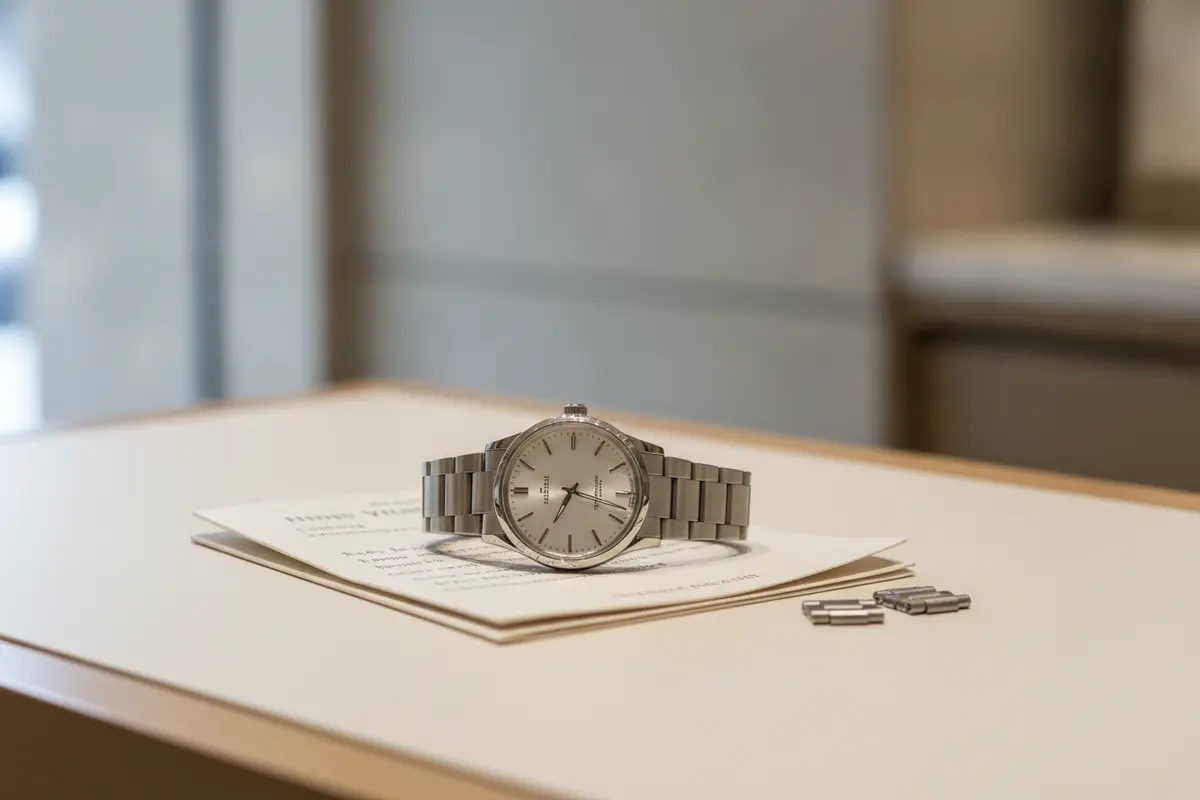
Do not try to improve apparent condition just before the visit. Polishing may change surfaces, and aggressive cleaning may obscure details or create damage. Leave the watch as it is, including ordinary wear. If it is not running, explain when you last saw it working, if known, and bring any service note that may clarify the issue. The goal is an accurate description of the piece as presented, not a cosmetic makeover.
What does provenance add to a watch appraisal?
Provenance means the documented history of an item. For a watch, useful evidence can include dated purchase documents, service records, prior appraisals, and a consistent account of ownership. Paperwork may support identification and context, but it does not by itself establish condition or a particular value.
Make a simple timeline before your appointment: when you acquired the watch, where it came from if known, and any service or changes since then. Separate what you can document from what you remember. If the watch was inherited, you can explain that without presenting uncertain details as proven facts.
For example, note that you received the watch from a relative in a particular year if you know that, and distinguish it from a story you heard but cannot verify. If a receipt lists a purchase date or a service invoice lists replaced parts, put those documents in chronological order. A concise, honest account is more useful than an elaborate story with uncertain details.
Provenance can be especially helpful when a watch has changed hands or undergone work. It may help the appraiser understand why a component differs from what is expected or why the current configuration is not the one shown in old photographs. It cannot substitute for examining the watch itself, and it should not be used to imply a connection or ownership claim that the records do not support.
Which factors can influence an appraised value?
The appraiser considers the specific watch and the purpose of the report. A valuation may reflect the maker and model, materials, condition, originality, completeness, documentation, and market evidence relevant to the assignment. Demand and the availability of comparable examples can change over time.
There is no reliable way to calculate a professional appraisal from a single detail such as age, purchase price, or a photograph. Two watches that look similar may differ in reference, components, condition, or history. Likewise, the original amount paid does not necessarily equal a current insurance value or resale result.
| Information to compare | What it can help explain | What it cannot establish alone |
|---|---|---|
| Purchase paperwork | Purchase details and a point in the ownership history | Current condition or current value |
| Service records | Known maintenance or component work | That every component is original or the watch is in a particular condition today |
| Physical inspection | Visible condition and identifying features at the time of review | Future sale price or guaranteed performance |
| Comparable market information | Context for a value opinion, depending on the assignment | A guaranteed offer or future market result |
Comparisons require care. A listing price is an asking price, not proof that a comparable watch sold for that amount. Completed transactions can also differ by condition, included papers, accessories, seller terms, and timing. An appraiser should consider evidence appropriate to the report's purpose rather than treating one online listing as a definitive benchmark.
Metal content is another detail, but it is not always a shortcut to value. The watch may have value beyond its raw materials, and the appraisal considers the whole object and assignment. Conversely, a precious-metal case alone does not establish a particular market result. Avoid estimating from weight or a generic online calculator when you need a documented opinion.
When comparing reports, look beyond the headline amount. Check the date, purpose, item description, assumptions, and whether the report explains its method or limitations. If a figure seems surprising, ask what evidence supports it and whether the underlying purpose matches the document you need. A transparent explanation makes it easier to use the report appropriately.
How can an appraisal support insurance records?
Some owners seek an appraisal to help document a watch for insurance purposes. The appraisal may give the insurer information about the item and a value opinion, but it does not itself create coverage. Coverage, limits, deductibles, exclusions, and documentation requirements are set by the insurance policy and insurer.
Before the appointment, ask the insurer what it needs. It may have specific requirements for the report, item description, photographs, or valuation date. Confirm whether the insurer accepts the appraiser and report format you plan to use. That simple check can prevent paying for documentation that does not meet the recipient's requirements.
After receiving a report, provide it to the insurer through its requested process and keep a copy with your household records. Ask whether a separate schedule or endorsement is needed. Do not assume that adding a document to a file automatically changes your policy or confirms protection for every circumstance.
The National Association of Insurance Commissioners explains that homeowners policies and coverage details vary, so policyholders should review their policy and speak with their insurer about coverage: NAIC homeowners insurance guidance. That general guidance supports an important practical point: an appraisal and an insurance contract serve different purposes. The insurer can explain how your particular watch is treated under your policy.
How is an appraisal different from a sale estimate?
An appraisal documents a value opinion for a stated purpose. A buyer’s offer is a separate decision shaped by the buyer’s terms and the transaction. Asking prices are not the same as completed sales, and neither should be confused with an insurance replacement figure.
If you are considering selling, say so before the assessment and ask what the jeweler can and cannot provide. Kravit Jewelers offers gold buying, but that does not establish acceptance or valuation terms for a watch. For watch-specific questions, contact the store to confirm the scope before visiting.
Ask Kravit Jewelers about the right next step for your timepiece
How can you prepare for a professional appointment?
Use this checklist to keep the meeting focused:
- Write down why you need the appraisal and who will use it.
- Gather the watch, paperwork, box, extra links, and service records you have.
- Make a short ownership and service timeline, marking any details you cannot verify.
- Note questions about report contents, fees, timing, and whether the watch must be left for examination.
- Ask how the final document will identify the watch and state the purpose and date of the value opinion.
- Keep the report and supporting records together, and check with your insurer about when an update is needed.
Also plan how you will transport the watch and documents. Keep the watch secure and avoid packing loose pieces where they might be misplaced. If you bring a box or extra bracelet links, place them in a separate pouch or container and tell the appraiser which pieces belong together. Bring copies of sensitive paperwork when possible, and retain originals unless the appraiser specifically needs to inspect them.
At the appointment, describe your goal before the examination begins. If the report is for insurance, say that; if you need records for an estate, explain that instead. Ask what inspection is included, whether the watch will remain in your possession, and how the final report will be delivered. Clarifying expectations early reduces the chance of misunderstanding what the appointment covers.
Do not assume an appraisal includes repairs, authentication beyond the assignment, or insurance coverage. Confirm the scope in advance. If the watch needs service, the separate watch-care consultation can help you ask about assessment and recommendations. Any work and timing should be discussed individually.
What questions should you ask before the appointment?
- What is the appraisal intended to document?
- What records or accessories should I bring?
- Will the watch be examined in person, and do I need an appointment?
- What will the written report include?
- Are there fees, and how will timing be determined?
- Should I contact my insurer about a specific report format?
You can also ask whether the appraiser needs identifying details in advance, what happens if documentation is incomplete, and whether the report will note areas that could not be verified. If you need the report by a particular date, mention that before booking rather than assuming a standard turnaround. Ask about fees and timing directly because the scope and complexity can vary.
These questions help align the assessment with your needs. A clear purpose is especially helpful when the watch has incomplete records, has been modified, or has not been examined recently.
How should you review and store the finished report?
When the report is ready, check that the description matches the watch you brought. Review the maker and identifying details, materials, condition notes, included accessories, stated purpose, value basis, and effective date. If you notice an error or omission, ask the appraiser how it should be corrected before relying on the document.
Store the report with receipts, service records, and photographs in a secure place. Keep a digital copy if appropriate, but protect personal information and avoid sharing detailed identifying information publicly. If you move, change insurers, or make a material change to the watch, ask whether you should update the documentation or notify the insurer.
A clear record can also help a future owner or family member understand what was evaluated and when. Label the file with the report date and purpose so it is not confused with a later assessment or a sale offer. Keep supporting records together rather than relying on memory to reconstruct the watch's history years afterward.
Frequently asked questions about watch appraisal
Should I have the watch cleaned before an appraisal?
No special cleaning is necessary. Avoid polishing or making changes before the appointment, since condition and originality are part of the information an appraiser may need to observe.
Can a photograph replace an in-person appraisal?
A photograph can help with an initial conversation, but it cannot show every detail needed for a full assessment. Ask the appraiser what examination is required for the report you need.
Does an appraisal guarantee what I could sell the watch for?
No. An appraisal is a value opinion for a stated purpose and date, not a guaranteed offer or future sale price. Ask for a separate explanation if you are considering a sale.
What if I do not have the original papers?
Bring the watch and any other records you do have. Tell the appraiser what is missing. The available evidence can be reviewed, and the report can reflect its limits.
Arrange a conversation about your watch appraisal
A little preparation makes it easier to explain what you own and why you need its value documented. Bring what you have, ask about the report’s scope, and treat the result as an informed opinion for its stated purpose.


