




Choosing emerald earrings means balancing color, setting, comfort, and the way you plan to wear them. Emeralds bring a distinct green presence to an earring, whether you prefer a quiet accent or a more noticeable pair. A thoughtful comparison helps you focus on the details that matter instead of relying on color alone.
Request a personal emerald earring consultation at Kravit Jewelers
What makes emerald color distinctive?
Emerald is the green variety of beryl. Its color can range from lighter green to deeper, richer tones. When looking at emerald earrings, compare both hue and saturation: hue is the basic color, while saturation describes how vivid or muted it appears. Also notice whether the color looks consistent across both stones and under more than one lighting condition.
Clarity is another part of the picture. Natural emeralds commonly have visible internal features, often called inclusions. They are not automatically a flaw that makes a stone unsuitable. Instead, look at how those features affect the overall appearance and whether they are distracting at the size and distance at which earrings are normally seen.
For a pair, compare the stones side by side. Check whether their greens feel harmonious, whether one appears noticeably darker, and whether the overall face-up size looks balanced. Exact sameness is not always realistic, but a pleasing pair should look intentional when worn together.
When comparing color, give your eyes time to adjust. Look at the earrings in diffuse daylight and in the kind of indoor light where you expect to wear them. A bright display spotlight can make color look more intense than it appears in ordinary settings. Turn your head slightly and notice whether the stones remain lively from different angles, or whether one seems dark when viewed from the side. These observations are more useful than trying to name a single ideal shade.
Ask what is known about the stones and whether they have received treatments. Emeralds are often treated to improve clarity, and care recommendations may depend on the stone and its treatment. The Gemological Institute of America provides general gemstone education at GIA; for a specific pair, ask the seller or a qualified gem professional to explain any available information. Do not assume two stones have the same treatment simply because they are sold as a pair.
It helps to distinguish what you can judge visually from what requires information or expertise. You can compare hue, brightness, face-up appearance, and how the pair looks together. You cannot reliably identify every treatment or determine durability just by looking at a photograph. If the seller has written information, ask whether it applies to each emerald, whether the stones are natural, and whether the document is an identification report or a sales description. Keep the answer tied to the exact pair you are considering.
Use this short viewing routine to compare emerald earrings consistently:
- Compare the pair side by side. Notice whether the green tone, brightness, shape, and face-up size feel balanced.
- View each earring separately. Check whether one stone looks noticeably darker or different from the other.
- Step back to normal conversational distance. Decide which pair looks attractive in ordinary lighting, not only under a display lamp.
- Repeat the same checks for every pair. A consistent order makes tradeoffs easier to see when you are comparing options.
Which earring settings help protect emeralds?
Setting choice affects both appearance and practical wear. Emerald is a relatively brittle gemstone compared with some other popular jewelry stones, and inclusions can make a stone more vulnerable to impact. Earrings are often less exposed to knocks than rings, but a secure setting is still important.
- Bezel settings: A rim of metal surrounds the stone's edge. This can provide a protected profile and a clean outline.
- Prong settings: Small metal claws hold the stone while leaving more of its surface visible. Ask how the prongs cover the edges and whether they feel secure.
- Halo settings: A border of smaller stones frames the emerald. This changes the visual scale and adds detail, but introduces additional settings to inspect and maintain.
- Drop settings: A suspended stone or design element creates movement. Consider whether the length and motion suit your daily routines.
No setting makes a gemstone indestructible. The best choice depends on the stone's shape, the design, and how frequently you expect to wear it. A jeweler can examine the specific pair and explain the tradeoffs.
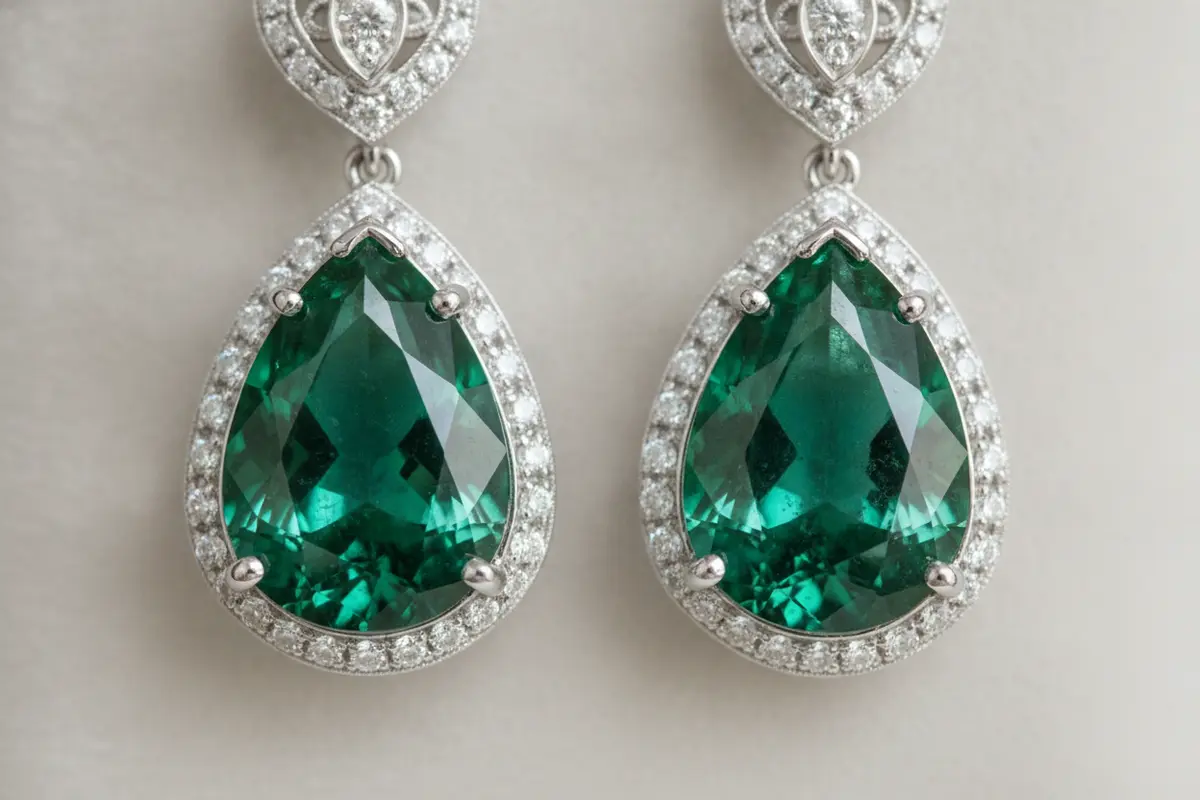
Look at the setting from the front and from the side. From the front, check whether metal obscures more of the emerald than you want. From the side, see whether the stone sits high or close to the ear, and whether the surrounding metal feels smooth rather than likely to catch hair. A low profile can be practical if you often wear headphones or pull on sweaters, while a more elevated setting may show more of the stone but can be easier to bump or snag.
Inspect the construction without trying to bend or test components. Prongs should appear aligned and should meet the stone securely; a bezel should follow the outline without obvious gaps. In a halo, look at the small surrounding stones and ask how the piece is checked and maintained. These are visual questions, not a substitute for an in-person assessment. If a stone moves or a component feels loose, do not wear the earrings until a jeweler has examined them.
How can you compare emerald earring settings?
Use a simple comparison to identify what matters most to you. These are general design considerations, not a guarantee that every setting offers the same level of protection or comfort.
| Setting style | Visual effect | What to consider |
|---|---|---|
| Bezel | Clean outline with metal around the stone | Ask how much of the emerald edge is covered and whether the profile suits your ear. |
| Prong | More visible gemstone surface | Check prong security and whether exposed edges fit your wear habits. |
| Halo | Framed, more detailed appearance | Consider the added visual scale and the extra small settings to maintain. |
| Drop | Movement and added length | Try to assess weight, length, and movement for comfortable wear. |
Use that chart as a first filter, then try to assess the actual scale of the earrings. A setting that looks delicate in a product photo may feel larger in person, while a bezel can make the outline appear broader than the gemstone itself. Compare total dimensions, not just the stone measurement. If you are shopping online, check the listed measurements and hold a ruler near your ear to imagine the proportions. A clear image beside a familiar object can help, but it cannot fully replace seeing how a piece sits when worn.
Closures deserve attention, too. Stud earrings may use posts with friction backs or screw backs; drops and hoops can use different mechanisms. Look for a closure that feels secure but is still manageable for you to fasten. If you have difficulty with small components, practice opening and closing the pair before deciding. Check that the earring's weight feels comfortable on the ear and that moving parts do not catch on hair or clothing.
Think about the whole earring, not only the gemstone. A larger backing or decorative element can change balance, and a drop's chain or articulated connection affects how it moves. If possible, try the earrings on and wear them for a few minutes. Notice pressure at the piercing, whether the front tilts forward, and whether the closure is easy to handle. Ask whether the pair can be adjusted if the fit is not right; do not assume an adjustment is possible without checking the construction.
For a useful side-by-side test, compare one practical issue at a time. First assess how secure and low-profile each design appears. Then compare weight and comfort. Finally consider appearance and maintenance. A dramatic setting may be the favorite visually but not the easiest for long wear. A simple stud may be convenient yet less expressive than you want. Identifying the compromise is more helpful than searching for a design that is perfect in every category.
How should you match a pair of emerald earrings?
Start by deciding whether you want a matched pair or a coordinated pair. Matched stones have a similar visual character; coordinated stones may vary slightly while still looking balanced. Compare color, shape, dimensions, and how each stone sits in its setting.
Metal color can change the overall impression. Yellow gold often creates a warm contrast with green, while white metals can give a cooler, crisp look. The right choice is personal, and it should also work with jewelry you already wear. If you plan to combine emerald earrings with a necklace or ring, bring those pieces when you compare options.
A useful way to compare pairs is to check one feature at a time. First compare the overall green, then the relative size and shape, and finally the brightness and visible inclusions. Step back to a normal conversational distance after looking closely. Earrings are usually seen from several feet away, so a tiny difference that is obvious under magnification may not change the impression when worn. Still, a noticeable difference in darkness, size, or outline can make a pair feel less cohesive.
Think about scale as well. Smaller studs can be discreet and easy to coordinate. Larger studs or drops make a more visible statement. The stone size, setting, and total earring dimensions all affect how prominent a pair looks.
When pairing earrings with other jewelry, decide whether you want repetition or contrast. Repetition might mean choosing a similar metal color or echoing a green accent elsewhere. Contrast might mean letting the emeralds stand alone against simpler pieces. Neither approach requires an exact match. If a necklace has a different shade of green, hold the pieces together and assess the overall effect in the lighting where you expect to wear them.
Consider your usual wardrobe and the way you style your hair. A green stud may be easy to see with hair pulled back, while a longer earring can remain visible with loose hair but may tangle more easily. Neckline and collar shape also influence how a drop sits visually. These are useful styling considerations, but comfort should remain central: if an earring catches repeatedly or feels heavy, it may not be the piece you reach for often.
For more ideas on choosing colored stones, explore Kravit's jewelry guides. You can also compare the character of emerald with the design considerations in this emerald ring guide. Although a ring faces different wear demands, the discussion can help you think about the stone's appearance and the role of setting design.
Before you settle on a pair, name your priorities in order. For example, you might rank a lively green first, comfortable all-day wear second, and a low-profile setting third. Someone choosing earrings for occasional events may prioritize visual impact and movement instead. A short priority list makes comparison easier because it gives you a reason to accept one tradeoff and reject another.
Compare fine-jewelry styles at Kravit Jewelers
What occasions suit emerald earrings?
Emerald earrings can work across a range of occasions, depending on their size and design. A simple stud may suit regular wear, while a drop or halo design can complement formal clothing. There is no fixed rule that a colored gemstone belongs only at special events. Your comfort, wardrobe, and preferred level of color are more useful guides.
Think about how the design works with your wardrobe rather than treating occasion labels as rules. A small green stud can add color to a simple weekday outfit, and a refined drop may feel appropriate for a dinner or celebration. The same pair can move between settings if its scale, weight, and detailing feel right to you. If you already wear glasses, headphones, or a particular hairstyle, consider whether an earring will sit comfortably alongside them. Long drops can move more and may be less convenient when you are active, while a compact style tends to stay closer to the ear.
Consider practical details before choosing a pair for frequent wear. Do you prefer earrings that sit close to the ear? Will you wear them for long stretches? Do you need a secure closure? These questions can help narrow the design before you focus on decorative details.
For travel or a busy day, think through when you would remove the earrings and where you would store them. A piece that is easy to take off but hard to secure in a bag may not be convenient. A small case with separate spaces reduces the chance of the earrings rubbing against one another or getting lost among other items. For special occasions, put earrings on after hair styling and remove them before changing clothes to reduce snagging. A few routine choices can protect the setting without making fine jewelry feel difficult to enjoy.
Consider how often you expect to wear the pair, not just where you will wear it. If the earrings will be used weekly, comfort and a closure you can manage may matter more than a dramatic silhouette. If they are for occasional celebrations, you might be comfortable with more movement or detail. Think about whether one versatile pair is more useful than separate everyday and formal styles. The answer depends on your habits, not a prescribed rule about gemstones.
If you are choosing a gift, try to observe the recipient's usual jewelry scale and metal preference. Do they wear small studs, hoops, or longer earrings? Are their everyday pieces yellow gold or a cooler metal? A discreet design can be easier to integrate when you are uncertain, while a more distinctive pair may suit someone who regularly wears statement jewelry. When practical, ask about closure preferences and sensitivities before buying. Avoid assuming that a dramatic size automatically makes a better gift.
Use the opportunity to look at the pair as it will actually be worn: with its back in place, hair in a familiar style, and clothing that might catch an earring. If you are in a showroom, turn your head gently and check whether the pair swings or rests as expected. This small trial can reveal a comfort concern that is not obvious when the earrings sit on a display pad.
How do you care for emerald earrings?
Handle emerald jewelry gently and follow care advice for the specific stones and setting. Avoid sudden impacts, and remove earrings before activities where they may be struck or caught. Store them separately in a soft-lined case or pouch so they do not rub against harder jewelry.
After wearing emerald earrings, take a moment to check the posts, backs, hinges, and visible prongs or bezels. Do not tug at a setting to test it; instead, look for a stone that appears to shift, a bent component, or a closure that no longer holds as expected. If you notice a change, set the pair aside and have it examined before wearing it again. Regular visual checks can help you notice a problem early, but they do not replace professional inspection when something seems loose or damaged.
Keep earrings in a separate compartment so their metal and gemstones do not rub against other pieces. When travelling, use a small jewelry case that keeps each earring secure rather than placing them loose in a bag. Avoid leaving fine jewelry where it may be exposed to household chemicals, cosmetics, or sudden temperature changes. Put earrings on after applying hair products and fragrance, and remove them before swimming, exercise, or tasks where they might be caught or struck.
For routine cleaning, use a soft cloth. Do not assume that every emerald can be cleaned with an ultrasonic or steam device; treatments and inclusions can affect what is appropriate. When in doubt, ask a qualified jeweler to assess the piece before using a cleaning method. Have the setting checked if a stone feels loose or the earring has taken a hard knock.
At Kravit Jewelers in Oceanside, the team can offer in-person guidance on fine jewelry and care questions. The family-owned jeweler has served Long Island since 1927, giving local customers a place to discuss jewelry choices face to face. For an assessment of a particular piece, bring it in so its condition and construction can be considered directly.
Before purchasing, make a short list of the points you want to resolve: how the pair looks in more than one light, how closely the stones match, what the setting covers, how the closure works, and what care is recommended. If the stones are accompanied by documentation, review what it identifies and what it does not. Ask whether the document describes the exact earrings or only a related stone, and confirm whether it addresses treatments or other details important to you. Clear answers make it easier to compare different designs on their merits rather than relying on a broad label.
For an in-person conversation, Kravit Jewelers serves the Long Island community from Oceanside and has operated as a family-owned jeweler since 1927. Bring the pieces you hope to coordinate with, if practical, and explain whether you are choosing earrings for regular use or a particular occasion. A face-to-face review can help you consider color, proportion, and comfort together. Explore other jewelry guides for related ideas, or view new fine-jewelry arrivals as a starting point for comparing design details.
Schedule your emerald earring consultation with Kravit Jewelers
Frequently Asked Questions About Emerald Earrings
Are emerald earrings suitable for everyday wear?
They can be, but suitability depends on the individual stones, setting, and your routine. A close-fitting design may be easier to wear regularly than a long drop. Ask a jeweler to assess the specific pair and follow appropriate care guidance.
Should both emeralds in a pair look exactly alike?
They do not need to be identical, but they should look balanced together. Compare color, size, shape, and brightness side by side in more than one lighting condition.
Can emerald earrings be cleaned at home?
Gentle wiping with a soft cloth is a cautious starting point. Avoid ultrasonic and steam cleaning unless a qualified professional confirms that the particular stones and treatments can tolerate it.
What should I do if an emerald earring feels loose?
Stop wearing it until the setting has been checked. A jeweler can examine the stone and mounting and discuss suitable next steps.
Ready to Compare Emerald Earrings?
Look closely at color, compare both stones as a pair, and choose a setting that fits your habits and preferred style. A personal examination can help you weigh those details and select emerald earrings with confidence.

